Wednesday, September 26, 2012

SAINT HILDEGARD- 12th CENTURY BLOGGER


St.  Hildegard wrote letters to popes, cardinals, bishops, abbots, kings and emperors, monks and nuns, men and women of various social levels both in Germany and abroad.  Some of her letters are more personal, but the majority are mystical treatises, prophecies, sermons, and strong exhortations concerning the various corruptions of the day. St. Hildegard’s clear intelligence foresaw that the ecclesiastical and political abuses of her time would ultimately lead to the catastrophic events of the Reformation and the Thirty Years’ War.

Her letters have been translated into the English and fill 3 volumes. This study consists of nearly four hundred letters. Addressed to some of the most notable people of the day, as well as to some of humble status, the correspondence reveals the saint in ways her more famous works leave obscure: as determined reformer, as castigating seer, as theoretical musician, as patient adviser, as exorcist.


Sometimes diffident and restrained, sometimes thunderously imperious, her letters are indispensable to understanding fully this medieval saint and her works. In addition, they provide a fascinating glimpse at life in tumultuous twelfth-century Germany, a period of schism and political unrest. This first volume includes ninety letters to popes, archbishops, and bishops.

In the second volume are letters to lower-ranking spiritual leaders (abbots and abbesses, for the most part) offering advice and consolation, and is particularly noteworthy for the correspondence with Guilbert of Gembloux, who provides a wealth of information about the saint and her spiritual gift.
St. Guilbert of Gembloux

The third volume contains  letters to a non-ecclesiastical audience, letters not just to such high-ranking notables as Frederick Barbarossa, King Henry II of England, or Eleanor of Aquitaine, but also to common, ordinary individuals of no importance whatsoever, excpet that they received a letter from St. Hildegard of Bingen.

St. H. original "Blogger" (Dutch)
 Addressing matters as diverse as the "humors" and their relation to health and salvation, the fate of departed souls, the frequency and horror of homicide in her age, the proper attitude and response to the fact of excommunication, and male infidelity in marriage, St.Hildegard provides a unique view of the twelfth century world. Here also are found compositions in style that are actually sermons, mediations, prayers, or treatises on a wide range of theological topics, such as prophecy, celebration of the Mass, the Lord's Prayer, the creation, and the fall of Adam. Her letters are a good way to begin to understand this often mysterious saint and her age.


(this says it all!-Pablo Morales de los RĂ­os- Spain )

Tuesday, September 25, 2012

GERMANY'S FIRST FOODIE

Br. Robert Lentz, OFM
Among St. Hildegard's writings are her thoughts and opinions on the physical values of various foods. When I was at our monastery in Italy in 1993, I discovered a cookbook called: in the Kitchen with St. Hildegard.

Italian
 I waited many years for it to be released in English. Now it has been translated into almost very language in the western world.

From Saint Hildegard's Kitchen: Foods of Health, Foods of Joy by Jany Fournier-Rosset
This rather unusual cookbook derives its recipes from the saint's theological and visionary writings, although a few are directly from the saint herself.

This is not a meat and potatoes diet, but surprisingly well-balanced, considering the limitations of medieval fare. There is an emphasis on greens and grains, especially spelt, which  today many health-conscious include in their diet. Dishes vary from the simple, using only a few ingredients, to the much more complicated, requiring a very well stocked pantry.

Some of the ingredients may be unfamiliar to most modern cooks in this country but for us monastics, not so. For an example, nettles, are generally considered a weed, but St. Hildegard makes an omelet with them, praising their purgative, restorative, and stimulative virtues.

When I was a novice I was big on natural foods found in our woods and fields, often cooking them for the Community. Nettles were a favorite, especially Scottish nettle-barley soup.

St. Hildegard divided foods according to their "healing" properties.

spelt
Spelt is the basis of her cooking, followed by fruits and vegetables and a modest use of meat, game, fish, milk and milk products, herbs, spices and drinks. St. Hildegard did not rate the food according to it’s calories but according to their medicinal values. 

For St. Hildegard healthy foods were beans, butter, spelt, sweet chestnuts, fennel, spice cakes, honey, carrots, garbanzo beans, squash and its oil, almonds, horseradish, radishes, raw sugar, red beets, cooked celeriac, sunflower seed oil, wine vinegar, cooked onions, apples, cooked pears, blackberries, raspberries, red currants, cherries, mulberries,quinces, grapes, citrus, dates. Healthy meats were poultry, lamb, beef, venison, and goat (what is left??) and she loved fish.

St. Hildegard's highest rated foods are spelt, chestnuts, fennel and chickpeas (garbanzo beans). "Spelt creates healthy body, good blood and a happy outlook on life," she writes.

Meat should be from animals which eat grass and hay and don't have too many offspring  ( a thought to modern growers who force feed in unnatural stock yards). Butter and cream from the cow are good, but milk and cheese are better from the goat (hmmm, we won't tell our milk customers that!). Sunflower and pumpkin seed oils are good but olive oil is reserved for medicinal purposes (Italians have something to say about this).

She says to stay away from "Kitchen Poisons" such as eel, duck, crab, pork, fatty meats, peas, cabbage, cucumbers, leeks, lentils, mushrooms, peaches, plums, strawberries, blueberries, elderberries, refined sugar, white wheat flour, and raw food. "In case of disease such as cancer, no animal protein should be eaten at all".

For drink she recommends beer. Some think she "invented" this drink as we know it today.  Her writings include the earliest known reference to using hops in beer.

Hildegardishof, Bingen-Rudesheim
When put in beer hops "stops putrification and lends longer durability." Today the nuns at St. Hildegard's Abbey on the Rhine are famous for their wines. Beers??? I don't think so!

Wines from the nuns at St. H. Abbey


St. Hildegard's Cookies of Joy
St. Hildegard said that these spice biscuits "should be taken at regular intervals to increase joy and positivity".
(I suppose like any good mother, she knew sugar and spices make us all content, even for a short while).


Ingredients
3/4 cup butter
1 cup brown sugar
1 egg
1 tsp baking powder
1/4 tsp salt
1 1/2 cups flour (can be part whole wheat or spelt)
1 tsp ground cinnamon
1 tsp ground nutmeg
1 /2 tsp ground cloves

Heat oven to 350°.
Cream butter cream  with the brown sugar. Beat in the egg. Sift the dry ingredients. Add half the dry ingredients and mix. Add the other half and mix thoroughly. Dough may be chilled to make it workable. Form walnut sized balls of dough, place on greased and floured cookie sheet and press flat. Bake 12-15 minutes till edges are golden brown. Cool for 5 minutes, then remove from cookie sheet and finish cooling on racks.  Makes about 30 cookies.

Monastery Nettle-barley soup
In the springtime harvest young stinging nettles, about 10-12 cups. (be sure and wear gloves- they will be safe to touch once blanched!). Wash and chop.
Cook one cup of pearl barley in 8 cups of beef  broth with the chopped nettles.
Cook covered over low heat for 30-40 minutes, until barley is cooked.
Season with salt and pepper. Serve hot.


Monday, September 24, 2012

MEDIEVAL HEALER of the RHINE


St. H. in monastery garden


When in the Novitiate I used to say that the only things St.Hildegard and I had in common were headaches (not migraines but Connecticut sinus) and herbs. I had a huge herb garden with over 100 herbs, for kitchen and infirmary and loved concocting new remedies. My mentor was our Mother Jerome, who was born in Bavaria and raised in Italy.

St. Hildegard is considered the first German woman physician and is called the mother of German botany.

Her book Physica is an encyclopedic work describing the characteristics of elements, mammals, reptiles, fish, birds, trees, plants, metals, and precious stones and jewels. The longest and most comprehensive section contains information concerning the medicinal uses and harvesting of more than 200 herbs and other plants. Unlike many other medieval herbals, this one contains little description of the plants for identification purposes.
 
With its emphasis on balancing the humors, Physica has strong affinity with the Oriental medical approaches gaining great respect today. The modern reader interested in natural healing will recognize the enormous truth in the theories of this 12th century physician, many of which prove effective today, serving as a reminder that our cures for illness depend on our natural world and our place in it. As St. Hildegard writes, “With earth was the human being created. All the elements served mankind, and sensing that he was alive, they busied themselves in aiding his life in every way”.


Causae et Curae catalogs forty-seven diseases according to causes, symptoms, and treatments. St. Hildegard lists more than 300 plants here, emphasizing medical and physiological theory as well as herbal treatments.

While St. Hildegard’s sources are not known, it is likely that she used medieval herbals and older texts by Pliny and St. Isidore of Seville, augmenting published information about illnesses and treatments with local folk and medical lore, observation, and experimentation. Her monastery at Rupertsberg had a large herb garden, from which medicines were prepared to treat members of her order as well as people from the surrounding countryside. St. Hildegard knew these plants by both their Latin botanical names and their common German names. St. Hildegard gave physical events, moral truths, and spiritual experiences equal weight. Healing was both medical and miraculous, and God’s will was an important element in her remedies. 


One principle in the saints works is viriditas, usually translated as “greenness” or “greening power” and interpreted as meaning growth or life. St. Hildegard wrote that God transmits life into plants, animals, and gems. People eat plants and animals and acquire gems, thus obtaining viriditas. They, in turn, give that life out by practicing virtue, becoming an important link in the chain of being.

St. Hildegard’s use of herbs, diet, and natural remedies to achieve health resembles today’s holistic approaches, and she prescribed small doses, foreshadowing those of homeopathic medicine. In her medical works as well as in some of her other writings, she deals with diabetes, gynecological and obstetrical concerns, and psychological causes of illness.

Although her theoretical knowledge of medicine seems crude today, large numbers of sick and suffering persons were brought to her for cures.  While most people today view St. Hildegard’s medicine as folkloric, a few take her theories seriously. Dr. Gottfried Hertzka of Germany has practiced “Hildegard medicine” for forty years, using Causae et Curae as his guide. 


In the 1980s, he was joined by Dr. Wighard Strehlow, a research chemist, at the St. Hildegard Center on Richenau Island in Lake Constance. In 1993, he moved his practice to the Hildegard House in Allensbach, a small town in southern Germany. Diet, diagnosis, and herbal remedies based on St.Hildegard’s writings are available there.

In the final analysis, this medieval saint practiced in her life the wisdom of her founder, St. Benedict: the bottom line being BALANCE  in all things.

Sts. Benedict & Hildegard

Saturday, September 22, 2012

SAINT HILDEGARD'S MUSIC


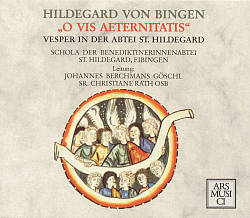
Perhaps the one facet of  St. Hildegard's genius most known throughout the world is her music. It has been recorded in every country in the western world. When I lived in Germany I got several of the recordings of her music sung by the nuns at her Abbey.

 To this day I think these recording more readily capture the essence of who she is, and the beauty of her work, than any of the professional groups singing her music. One reason is the music is sung in the Abbey Church which is solid stone and I am sure is what the saint herself would have known. The music echoes and floats. Another reason is the nuns are praying not performing, thus there is more of a spiritual quality to the music. 

Musically, the most important thing that St.Hildegard experienced as a child in the monastery was the opportunity to take part in the Divine Office. Every day, the nuns sang during the Divine Office and at the celebration of the Eucharist. Most of St. Hildegard's music was written for the eight  hours of the Divine Office. The hours consisted of readings from scripture and singing of the psalms and hymns which gave the nuns an opportunity to encounter God through a specific mood or season of time. She wrote music and texts to her songs honoring saints and Virgin Mary for the holidays and feast days. St. Hildegard produced poetry and music for more than 71 liturgical songs and a morality play.


Without formal education in singing or music she began to compose. St. Hildegard was a very passionate person so as a composer, she expressed herself both in the sound and in the words of her music. In contrast to the narrow scope of most chants in her day, her music has a very wide range. She uses extremes of register as if to bring heaven and earth together. Plainchant rarely used intervals larger than a second or third. St. Hildegard's music vaults upward and downward with wide intervals of fifths and fourths giving it a very ethereal quality.

While St. Hildegard's visions and music have been hijacked by the New Age, there are plenty of wonderful recordings out there. Her music had something of a “pop culture” moment back in the mid 90s, when Richard Souther’s album Vision: The Music Of Hildegard von Bingen became a hit. It ended up winning the Billboard Classical/Crossover album of the year award.


Purists recoiled at the use of modern instrumentation. But who is to say that future artists should rule out any similar innovations as they rediscover St. Hildegard’s music for the 21st century?
After all, the saint herself was a mystical genius who pushed beyond the boundaries of the musical conventions of her own time.


Some say the best recording was Emma Kirkby's, A Feather On The Breath Of God (1982).


But if I had to recommend a single purchase for someone wishing to learn from this saint, it would have to be the complete works of St. Hildegard recorded by the ensemble for medieval music, Sequentia- an amazing project released in successive years during the 1990s, that is unless you can get the real deal by the German nuns at St. Hildegard's.


                                BLESSED LISTENING!


Friday, September 21, 2012

VISIONS

Jane Lieber Mays

In this blog I will deal with St. Hildegard's spiritual life, which is very complicated, but sets the stage for other works to come. So bear with me as we continue on this journey of her amazing life.

Nothing would have seemed extraordinary about St. Hildegard for the first half of her long life. She did not wish to publicize the visionary experiences she had been having since the age of three when a blaze of dazzling brightness burst into her sight.
St. H. with Jutta


A diffuse radiance which she called her "visio" filled her field of vision for the rest of her life without interfering with ordinary sight. St. Hildegard came to understand this phenomenon as “the reflection of the living Light” which conferred the gift of prophecy and gave her an intuitive knowledge of the Divine.

St. Hildegard’s visions were not apparitions or dreams. She rarely fell into ecstasy but rather perceived sights and messages with the “inner” eyes and ears of her soul. She dictated to her secretary what she “saw” and “heard” while fully lucid. The astonishing images she saw she described to others to illustrate.


 They feature sparkling gems, shimmering orbs, pulsating stars, towers and crenelated walls. Modern psychologists have said that St. Hildegard suffered from a form of migraine called “scintillating scotomata.”
Agrios, Spain


 The debilitating illnesses that preceded or accompanied her visionary episodes might have been migraine attacks. Because supernatural communications are received according to the capacity of the receiver, neurology can offer insights on her physical manifestations but it cannot explain away her experiences or the religious meanings she assigns to them. These were genuine occasions of contact between St. Hildegard and God, and, as they say: God works in mysterious ways.

In 1141 heaven opened upon St.Hildegard as “a fiery light of exceeding brilliance” and a mighty voice commanding her to “tell and write” what she sees of God’s marvels. St  first she quailed at her call. Pleading her sickly female constitution and lack of formal education, she fell ill. But she confided in the monastery's provost, who shared the matter with his abbot at Disibodenberg, who urged her to accept her call. She rose from her bed and set to work on her first book, Scivias which succeeds in spanning the history of salvation from the creation of the world and man, to redemption and fulfillment at the end of time.

Konstantin Ugrinov, Germany
 
St. Hildegard attempts to describe the unspeakable mystery of God in ever-new images. Her visions are all composed in the same way: the vision itself as seen; the explanation of the vision; and the theological and spiritual explanation.
Liber Div. Operum

Equally impressive is the elemental power of imagery in her language, though it must be said that this, at times, does not make it easy for us modern mortals to comprehend St. Hildegard's thoughts and interpretations. She was as much a master of the narrative style as of the dramatic, the scientific as much as the lyrical and she filled old concepts with new meaning.

St. Hildegard’s three major theological books are: Scivias (Know the Ways) , Liber Vitae Meritorum (The Book of the Rewards of Life), and Liber Divinorum Operum (The Book of Divine Works). They deal with microcosm and macrocosm, the Trinity, Fall, Incarnation and Redemption, vices and virtues, sacraments, angels and Satin, Genesis and the Gospel of John, Antichrist, the End of the World and the joys of Heaven. St. Hildegard‘s keyword, viriditas, communicates the fertile, green freshness of unspoiled Paradise. Her visions reveal the luminous presence of God permeating all creation, calling forth life so that matter and spirit will unite in a chorus of eternal glory.

Due to the confusion of the times, in the Church and outside, St. Hildegard  asked advice from Bernard of Clairvaux who encouraged her in her work. Meanwhile, her local abbot notified the archbishop of Mainz who mentioned her to Pope Eugenius III, then visiting Germany.
St. H., with  Pope Eugenius III

After a papal commission reviewed chapters of Scivias, the pope approved St. Hildegard’s writings and read portions to a regional synod at Trier in 1147.
 
Now certified by the highest authorities, St. Hildegard became a celebrity seer whose counsel was treasured by rulers, clerics, and laity from England to Byzantium. Visitors streamed to her monastery seeking advice and cures from the “Sibyl of the Rhine.” (This fame was one reason why the Disibodenberg monks opposed St. Hildegard’s move to a new location.)

Despite the startling quality of St. Hildegard’s messages, her theology was orthodox. She accepted traditional teaching on male hierarchy, the complementary character of masculine and feminine, and social mores.
Beate Heinen, German

 She condemned offenses against life: contraception, abortion, infanticide, suicide, and homosexuality. But any sin could be forgiven. Penance and the cultivation of opposite virtues remedied vices. During an address in 2010, Pope Benedict XVI called St. Hildegard’s humble deference to ecclesiastical authority “the seal of an authentic experience of the Holy Spirit.”

St. Hildegard’s one clash with Church rules hinged on a point of fact, not doctrine. In 1178, she and her nuns were placed under interdict for burying an excommunicated benefactor in their graveyard. Knowing that he had been reconciled before his death, they endured months without the sacraments or music until cleared by the archbishop of Cologne. St. Hildegard died peacefully the following year, at the venerable age of 81.

Death of  St. Hildegard, Fr. Paulus Krebs (Abbey St. H)


Wednesday, September 19, 2012

PERSONAL NOTES (on SAINT HILDEGARD)


I am often asked how I got the name Hildegard.  When I was first clothed (1970) no one in the USA had heard of St. Hildegard (unless they were German). After I was clothed I had occasion to visit the library at Yale University.  At that point there was only one book about her in English and it was a novel. None of her works had yet been translated from the medieval Latin, into English. It was in the days before women "libbers" go a hold of her and made her the patroness of every wacko idea known to womankind!

I had spent 2 years in the Black Forest of Germany before I entered our Abbey in the East. While there I visited many Benedictine monasteries- monks and nuns. My favorite of all was St. Hildegard's on the Rhine, which I was able to visit on several occasions, even staying one freezing week in February.

St. H. Abbey (Karl-Heinz Walter)

When Lady Abbess was considering a name for me she knew it had to be German (even though my family is 3/4 Celtic), and, knowing of my love for this Abbey on the Rhine she chose the name.

Our Lady Abbess (and foundress in this country) had been in an ancient Abbey in France during WW II and because she was an American, she had to often hide from the Gestapo. One of the names given to her was Hildegarde (French sp.). She hated the name, as it was a very painful period in her life. She gave me the name, hoping I could somehow "redeem" this time of suffering for the German people.

Our Foundress


At the time I was a novice, our Mother Columba, who had done translations in many languages, for the Classics of Western Spirituality series (Paulist Press), was asked to do one of St. Hildegard's Scivias.  It was a labor of many years, since the Latin of St. Hildegard's time was unlike what we know (publ. 1990). At the time Mother Columba was doing her work,  Adelgundis FĂ¼hrkötter,OSB of St. Hildegard's Abbey was completing her translation of the same work into German, so Mother Columba was able to confer with her.


Our Mother Placid did the cover for this book (and several other covers for the series). Mother Columba died soon after Scivias was published, but Mother Placid is still with us, though at this writing it is said her days are few.
Cover by Mother Placid, OSB


Not long after I was given the name Hildegard we discovered that it means "Battlemaiden" in German, which caused everyone who knows me to think Lady Abbess a visionary herself!


MH ringing bells- Seattle PI


Monday, September 17, 2012

FEAST DAY for the SYBIL of the RHINE

Today is the feast of  SAINT HILDEGARD of BINGEN

It is hard to decide where to begin on the long journey of her multi-faceted life.

St Hildegard by Fr Richard Cannuli (CNS)

St. Hildegard was born in 1098 and was raised in a family of  free nobles. Her parents were Hildebert and Mechthilde. Her father was a soldier in the service of  Meginhard, Count of Spanheim. Hildegard was a weak and sickly child, and thus received little education at home. Her parents, though engaged in worldly pursuits,  promised the child to the service of God. At the age of eight she was placed under the care of Jutta, sister

Hildegard being presented to Jutta
of Count Meginhard, who lived as a recluse on the Disenberg in the Diocese of Speyer. Here also Hildegard was given little instruction since she was much afflicted with sickness. She was taught to read and sing the Latin psalms, sufficient for the chanting of the Divine Office, but never learned to write. Eventually she was invested with the habit of St. Benedict and made her religious profession. Jutta died in 1136, and Hildegard was appointed superior. Numbers of aspirants flocked to the community and she decided to go to another locality, impelled also, as she says, by a Divine command. She chose Rupertsberg near Bingen on the left bank of the Rhine, about fifteen miles from Disenberg. After overcoming many difficulties and obtaining the permission of the lord of the place, Count Bernard of Hildesheim, she settled in her new home with eighteen nuns in 1147. Around 1165 she founded another convent at Eibingen on the right side of the Rhine, where a community had already been established in 1148, which, however, had no success. This is where the Abbey which bears her name stands today.

St. Hildegard's Abbey, Rudesheim, Germany


St. Hildegard was a visionary. Through much of her life, she experienced powerful visions, some of which she dictated and which are contained in three volumes. She illustrated these texts herself, which are unique and powerful in their originality. She also wrote poems, plays, hymns (many of which today can be found in recordings).
Marco Antonio Goday, Brazil

Her play Ordo Virtutum is about morality and is the only Medieval musical drama to have survived with both the text and music.

She made up an alternative alphabet and modified Medieval Latin by using many invented and abridged words, and named it Lingua Ignota. She mainly used it to increase solidarity among her nuns. 

She advised popes, bishops and kings (especially the German Holy Roman Emperor, Barbarosa) .
Advising Barbarosa  (Abtei St. H.-Germany)


Her prophetic mind wanted to rouse the people of her time, persuade them to change their ways and act against a growing godlessness. She often traveled to preach God's messages. When the Church questioned her visions and words, St. Bernard intervened, proclaiming her a woman of God.


St. Hildegard perceived herself as God's advocate, spokeswoman and instrument. Time and again she directed attention to the mystery of the Almighty and disclosed divine love to her readers and listeners as the source and completion of all being. Her visions she dictated to her scribe, the monk Volmar.
St. H. with Volmer


Even though she suffered from poor physical health her whole life, she was a woman of indomitable energy and great mental strength.

She is today noted for her works on medicine and natural history and knowledge of the curative powers of natural objects, especially herbs, and is sometimes regarded as one of the sources of modern medicine. She wrote the books Physica (about the study of botany, zoology, elements, metals and stones; describing their physical and medinicial proporties) and Causae et Curae  (about the study of causes and cures of diseases). Due to her lack of a formal education, experts are puzzled by her knowledge of so many areas of science.

Creator Mundi

She did all this during a time in which women were accorded little respect as artists and intellectuals, yet the effects of her experiments and advancements in music, art, and healing continue to this day.


The next blogs will deal in detail about the various facets of her extraordinary life.