Friday, October 19, 2012

SAINT KATERI AND JEWISH FRIENDS- A PERSONAL NOTE


Gift to OLR from the Wilsons in MT. (King Kuka-Blackfoot Artist)

When I was completing my doctorate, I had several chances to lecture in Montreal.

The first time, my dear friend and mentor, Ira Perrell ( a non-practicing Jew) came with me. I asked him if he would like to stop at the reservation where Bl. Kateri Tekakwith was buried. Ira, being open to any adventure, said why not and it was on our way to Montreal.

I am sure that after the beatification of  St. Kateri in 1980, tourism  greatly increased since the days when I was there. I remember poverty, dirt roads, and somber faces. Ira and I had not eaten and found an unmarked house where people seemed to be sitting inside. They were quiet and shy of us, but pleasant.


We went in to the very small restaurant, no menu, but we were game for anything. For less than the tip Ira left, we ate a wonderful meal starting with a pea soup with huge hunks of ham. It was so thick the spoon could stand in the bowl. The rest of the meal is lost to my memory, but Ira often spoke of that side trip, esp. as we stood on the banks of the peaceful  waters. Ira died this year, so the memory of that trip is more meaningful now.


Looking across the St-Lawrence River & Seaway (at Kahnawake)


The next year I was again in Montreal. My  (practicing) Jewish friends Myrna and Monroe were also there visiting friends and wanted to take me to some of the "tourist" places in Montreal. Ah ha, I said I have a place to show you, so we crossed the waterway  to Kahnawake. I still have the photos Monroe took of "Minnie" and I at the shrine and standing along the beautiful  waterside.


 When St. Kateri died, two French settlers so moved by the sight of her radiant, peaceful face built a wood coffin to hold her precious remains. When the mission moved from one location to another, her bones were too valuable to leave behind and were exhumed. The coffin made identification possible because St.Kateri was the only Indian buried in such a fashion.


Her grave stone reads:
            Kateri Tekakwitha  Ownkeonweke
    Katsitsiio  Teonsitsianekaron

"The fairest flower that ever bloomed among red men".
Artist-  Regina Ammerman, AZ


Wednesday, October 17, 2012

SAINT KATERI TEKAKWITHA- NEW SAINT


Painted by Fr. Chauchetière in 1696.

On October 21 KATERI TEKAKWITHA, the "Lily of the Mohawks", becomes the first Native American woman to become a Saint. She was born in 1656 at Ossernenon, which today is near Auriesville, New York, USA. Her father was a Mohawk chief and her mother was a Catholic Algonquin. Her baptismal name is Catherine, which in the Iroquois languages is Kateri. Her name can be translated as, "One who places things in order."

When she was four smallpox attacked the village, taking the lives of her parents and baby brother, leaving St. Kateri an orphan.  Although forever weakened, scarred, and partially blind, she survived. Since the brightness of the sun blinded her, she would feel her way around as she walked.

She was adopted by her two aunts and her uncle, also a chief.  After the smallpox outbreak subsided, the saint and her people abandoned their village and built a new settlement, called Caughnawaga, some five miles away on the north bank of the Mohawk River, which today is in Fonda, New York.

Jan Oliver

St. Kateri grew into a young woman with a sweet, shy personality.  She helped her aunts work in the fields where they tended to the corn, beans, and squash, and gathered roots in the forest needed to prepare medicines and dyes. Despite her poor vision, she also became very skilled at bead work. 


Although the saint was not baptized as an infant, she had fond memories of her prayerful mother and of the stories of  the Catholic faith that her mother shared with her in childhood. These remained indelibly impressed upon her soul and shaped her calling. She often went to the woods alone to speak to God and listen to Him in her heart and in the voice of nature.

Deacon Lawrence Klimecki
When she was eighteen, a Jesuit missionary came to Caughnawaga and established a chapel. Her uncle disliked the "Blackrobe" and his strange new religion, but tolerated the missionary's presence. St. Kateri remembered her mother's prayers, and was fascinated by the new stories she heard about Jesus Christ. She wanted to learn more about Him and to become a Christian. 


Nicholas Otero
Father de Lamberville persuaded her uncle to allow St. Kateri to attend religious instructions.  The following Easter, at the age of  twenty, she was baptized. Her  family did not accept her choice to embrace Christ, so after her baptism, she became the village outcast. Her family refused her food on Sundays because she wouldn't work. Children would taunt her and throw stones.  She was threatened with torture or death if she did not renounce her religion.

Because of increasing hostility from her people and because she wanted to devote her life to God, in July of 1677, St. Kateri left her village and fled more than 200 miles to the Catholic mission of St. Francis Xavier at Sault Saint-Louis, near Montreal. Here she received her First Holy Communion on Christmas Day, 1677.


Dorothy M. Speiser


Although not formally educated and unable to read and write, St. Kateri led a life of prayer and penance. She taught the young and helped those in the village who were poor or sick. She spoke words of kindness to everyone she encountered. Her favorite devotion was to fashion crosses out of sticks and place them throughout the woods. These crosses served as stations that reminded her to spend a moment in prayer.

St. Kateri's motto became, "Who can tell me what is most pleasing to God that I may do it?"  She spent much of her time in prayer before the Blessed Sacrament, kneeling in the cold chapel for hours. She loved the Rosary and carried it around her neck always.  


Dorothy M. Speiser

On March 25, 1679, St. Kateri made a vow of perpetual virginity, devoting herself to Christ for the rest of her life.  She hoped to start a convent for Native American sisters in Sault St. Louis but her spiritual director, Father Pierre Cholonec discouraged her. Her health, never good, was deteriorating rapidly due in part to the penances she inflicted on herself.  Father Cholonec encouraged St. Kateri to take better care of herself but she laughed and continued with her "acts of love."    

Br. Robert Lentz, OFM
The poor health which plagued her throughout her life led to her death in 1680 at the age of 24.  Her last words were, "Jesus, I love You."  Like the flower she was named for, the lily, her life was short and beautiful.  Moments after dying, her scarred and disfigured face miraculously cleared and was made beautiful by God. This miracle was witnessed by two Jesuits and all the others able to fit into the room.

Her feast is celebrated on July 14th in the United States. She is a patroness of ecology, nature, and the environment. 

1943- by the Polish artist Jan Henryk de Rosen. Pere Jacques Marquette, SJ; 
St. Elizabeth Ann Seton;  St.  Kateri Tekakwitha, St. Martin de Porres and Bl. Juniper Serra.


Tuesday, October 16, 2012

THE LLAMAS COME HOME- MORE DEATHS


OLR llamas
Too many friends and family are dying and while we know their suffering is now over and they are in a better place, we still, as frail mortals, mourn their passing.

I have written of my friend Larry, and my old mentor and good friend Ira will come up in a blog soon. Next to my brother Jeff, he was my most faithful e-mailer (new word?). I miss both their daily missives - everything from  jokes to great photos to world events. Ira was a true Renaissance man sharing his many gifts with all who knew him. He died March 18.
Ira Perelle


Then last week I had an unexpected visit from a friend's sister.  While she was here, her brother Tim died.  He was known in his area of Seattle as "the llama man" as he daily walked Eddie and Zorro  ( the potato chip eating llama) up and down residential streets. Crazy??? No, unless it was for the music he loved. To me he was the “twin” to Neil Young (I put a picture of him here as I have none of Tim- it gives you the idea!) His family has asked if I would take the "boys" back and since they are such sweethearts I have agreed. They will be delivered by the Seattle equestrian police division this weekend!  And that last concert with him??? I had hoped it would be with Neil!


Tim with friends


And then this morning came news of the passing of another friend, older than the others but  he will be no less missed.  He and his wife lived over the mountains in glorious Leavenworth and yearly my friend Sandi and her husband Larry and I would go to visit Les and his wife Jeanne. 
Leavenworth  (Bavarian-style town in the Mts.)


The saddest for us was the passing to the Father of Mother Felicitas' oldest son Carl at age 53 from pancreatic cancer on October 3. Carl had a B.S. in computer science from Rutgers University. Fresh out of college he moved to Silicon Valley in California where he worked for several companies developing software. After the new millennium he worked for himself selling collectable coins and trading a stock account.

At his passing there were many tributes to him from various collectors. These two give a window on the goodness of the man.

Carl Wohlforth

"I wanted to let you know, that out of all dealers/collectors I have dealt with, and there have been many, you are by far the most pleasant and easy to work with person I have ever dealt with."

“He is very astute when it comes to maximizing your returns, and perhaps most importantly, he is a person of impeccable integrity.”


For Mother Felicitas the greatest consolation came when Carl asked for Baptism just before he died. She and his wife Teresa were able to administer the sacrament as it was felt the priest would not get there in time. Many graces have been received for the whole family. He will be buried this Friday, October 19. 

I will just be returning from the mountains where Les will be placed. 


Carl's memorial card- his favorite place to hike, near San Jose

Monday, October 15, 2012

CALIFORNIA MISSIONARY


1939 drawing by Ramos Martinez

Growing up in California the MISSIONS are a part of our history and local scenery, but I am sure that in other parts of the country this Franciscan friar and his works are not so well known.

BLESSED JUNIPERO SERRA was born Miguel Jose Serra on November 24th, 1713 in Majorca,  Spain. He entered the Order of Friars Minor in 1730.  Because he was so good with his studies, Bl. Serra was appointed Lector of Philosophy before he was ordained. Later he received his doctorate from Lullian University in Palma De Mallorca.

Portrait as a young man.

In 1749, Bl. Junipero traveled to Mexico City. On the way from Vera Cruz to Mexico City, he was bitten in the leg by a snake. The bite never got better, and the leg bothered him for the rest of his life. He never wanted any help with it, preferring to walk whenever he could.

Plaza, Los Angeles


From Mexico City, he requested a transfer to the Sierra Gorda Indian Mission. He spent nine years there, learning the language of the Pame Indians, and translating the Catechism into their language. He was soon recalled to Mexico City and gained fame as being the most fervent and most effective preacher, because he would do anything in order to get people to repent.


In 1769 Bl. Junipero accompanied Governor Gaspar de Portola to Nueva California. The expedition landed in San Diego, where Bl. Serra founded Mission San Diego de Alcala, the first of  21 California missions. After founding Mission San Carlos Borromeo de Carmelo in Montery, Bl. Junipero relocated his headquarters to Carmel. Each of the California missions is located within one day’s walk of each other.

His beatification was been delayed for many years as some thought his treatment of the Indians was not fair, or that the peoples under his care were exploited. One only has to look at the history of those times to see problems everywhere, much not of the saint's making. He actually pressed for laws to protect the Natives from the abuses of the military. 


In a letter he wrote on 24th August, 1774, Bl.Serra explained that: "Every day Indians are coming in from distant homes in the Sierra... They tell the padres they would like them to come to their territory. They see our church which stands before their eyes so neatly; they see the milpas with corn which are pretty to behold; they see so many children as well as people like themselves going about clothed who sing and eat well and work." Serra wrote that he was especially pleased with the impact the missionaries were having on the children: "The spectacle of seeing about a hundred young children of about the same age praying and answering individually all the questions asked on Christian doctrine, hearing them sing, seeing them going about clothed in cotton and woolen garments, playing happily and who deal with the padres so intimately as if they had always known them."

Chart showing success at Mission San Francisco
Bl. Serra encouraged the Spanish sailors and soldiers to marry local women. He wrote that three of them had done so and that three others were considering the prospect. If they colonized the area, they received two years' pay and food rations for five years for themselves and their families. Bl. Serra believed that unless colonists began to live permanently near the mission, the missions would never become formal settlements.

Around 1778, Bl. Serra was given dispensation to give the sacrament of Confirmation. He went around confirming people for a year until Felipe de Neve told him to stop until he could present a Papal Brief.
Bl. Junipero waited for two years, until the Viceroy Majorga gave instructions to the effect that the saint was within his rights. Over the next three years, he traveled from San Francisco to San Diego, over 600 miles, and confirmed 5,309 people.


During the American Revolutionary War, Bl. Junipero took up a collection from his mission parishes throughout California. The total money collected amounted to about $137 ( not a small sum in those days) and the money was sent to General George Washington

On August 28, 1784, at the age of 70, Bl. Junípero Serra died at Mission San Carlos Borromeo. He is buried there under the sanctuary floor. He was beatified by Pope John Paul II on September 25th 1988.


The chapel at Mission San Juan Capistrano, built in 1782, is thought to be the oldest standing building in California. Known as "Father Serra's Church," it has the distinction of being the only remaining church in which Father Serra is known to have celebrated the rites of the Roman Catholic Church (he presided over the confirmations of 213 people on October 12 and October 13, 1783).  This mission is also the closest to where I grew up so we visited frequently. When I was in High School a "great date"  was a ride through the country and a picnic at one of the Missions, Santa Barbara and Santa Inez being favorites.


San Juan Capistrano
Statue at Capistrano


A statue of Friar Junípero Serra is one of two statues representing the state of California in the National Statuary Hall Collection in the United States Capitol. The statue, sculpted by Ettore Cadorin, depicts Serra holding a cross and looking skyward. 

Ettore Cadorin


Sunday, October 14, 2012

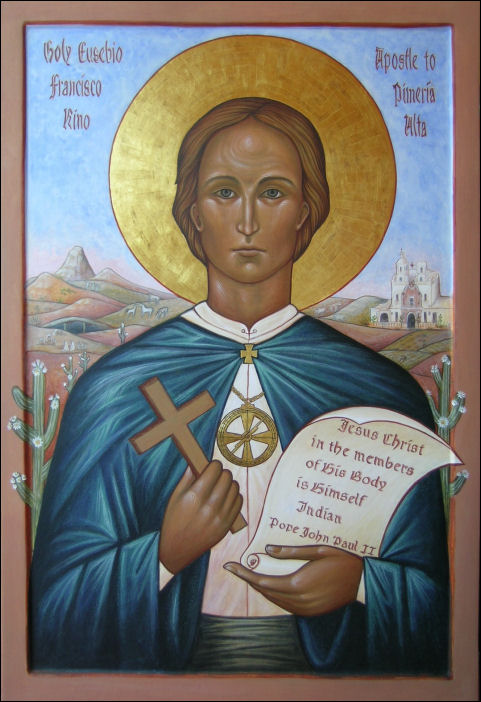
SERVANT of GOD FATHER EUSEBIO KINO: THE HORSEBACK PRIEST

Mahonri Young-Tucson
Sticking with our theme we once again present a saint who worked with the indigenous peoples in the USA.  SERVANT of GOD EUSEBIO FRANCISCO KINO, S.J. Even thought he lived over 400 years ago we know much about his life due to the many letters he wrote, his humanity and love of Christ, and his fame which spread among the peoples he taught and cared for.

Father Kino was born Eusebius Franz Kühn ( Kino in Spanish). His parents were Franz Kühn  and Margherita Luchi. The exact date of his birth is unknown but he was baptized on 10 August 1645 in the parish church, near Trent, Northern Italy. He was educated in Innsbruck, Austria. He became seriously ill at college in 1663 and made a vow to God that he would become a Jesuit and serve in the foreign missions as St. Francis Xavier had done if he recovered. Eusebio did recover and in gratitude to God’s goodness, he added Francis to his name. He joined the Society of Jesus in 1665, receiving religious training at Freiburg, Ingolstadt, and Landsberg, Bavaria.

Germán Orozco Mora
Mexico

 After completing a final stage of training in the Society, he taught mathematics. He was so competent in mathematics that the duke of Bavaria offered him a full professorship at Ingolstadt which he turned down as his heart was on the missions. He was ordained in 1677 and was sent to New Spain.

Father Kino's first assignment was to lead the Atondo expedition to the Baja California peninsula of the Las Californias Province of New Spain. He established the Misión San Bruno in 1683. After a prolonged drought there in 1685, Father Kino and the Jesuit missionaries were forced to abandon the mission and return to Mexico City.

In 1687 Padre Kino arrived in the Pimería Alta, at the request of the natives and quickly established the first mission in a river valley in the mountains of Sonora. He followed ancient trading routes established millennia prior by the natives. These trails were later expanded into roads. His many expeditions on horseback covered over 50,000 square miles, during which he mapped an area 200 miles long and 250 miles wide.

Padre Kino helped in the economic growth of  the area, working with the already agricultural native peoples and introducing them to European seeds, fruits, herbs, and grains. He also taught them to raise cattle, sheep and goats. His initial mission herd of twenty cattle imported to Pimería Alta grew during his period to 70,000. Historian Herbert Bolton referred to Kino as Arizona's first rancher.
Ina Hecker

He also taught them to build sturdy homes and at larger communities he founded schools for the children, taught them how to read and write and gave them instruction in the Catholic faith. In his travels in the Pimería Alta, Padre Kino interacted with 16 different tribes.

Ted de Grazia- Tucson

 Some of these had land that bordered on the Pimería Alta, but there are many cases where tribal representatives crossed into the Piman lands to meet the saintly Jesuit. He constructed nineteen villages which supplied cattle to new settlements. Padre Kino had an unusual amount of wealth for his vocation, which he used primarily to fund his missionary activities. His contemporaries reported on his wealth with suspicion.


Padre Kino opposed the slavery and compulsory hard labor in the silver mines that the Spaniards forced on the native people. This caused great controversy among his co-missionaries, many of whom acted according to the laws imposed by Spain on their territory.

Ted de Grazia-Tucson


He was also a writer, authoring books on religion, astronomy and map making. Padre Kino's later discovery that there was an overland route to California renewed the Jesuit mission efforts in Baja California that he first started 15 years before and made Padre Kino's maps world famous.


He built missions extending from the present day states of Mexican Sonora into present-day Arizona. At the invitation of the people of Bac, Padre Kino first visited their village in August 1692.


I visited this Mission  last year


Here he built the San Xavier del Bac mission, south of Tucson, which is still a functioning Franciscan parish church. During their 20 year friendship with Padre Kino, the people of Bac journeyed year-round to his missions in Sonora to help him and to receive his ministry.
.
Servant of God Eusebio Kino remained among his missions until his death in 1711. He died from fever at the age of 65, in what is present-day Magdalena de Kino, Sonora, Mexico. The saint is honored both in Mexico and the United States.

Padre Eusebio Kino was a man of great talents and his accomplishments were so widespread in southern Arizona that it chose him as one of its two representatives for the Statuary Hall in the United States Capitol in Washington.


Nereo de la Pena, Sonora, Mex. - his burial site

A movie was done on his life: Father Kino, Padre on Horseback (or Mission to Glory: A True Story)  1977. The movie is available in DVD format.


Rim of Christendom: a biography of Eusebio Francisco Kino, Pacific Coast Pioneer,  Herbert Eugene Bolton- University of Arizona Press, 1984.
(his earlier book Padre on Horseback)


After Padre Kino’s death in 1711, an increasing number of German-speaking Jesuits arrived in the region of  S. Arizona and soon dominated the entire missionary district. The Swiss  Philipp Segesser, (1689-1762) one of the most effective and industrious members of the Jesuit Order active  in the Southwest, has not yet been fully noticed because, until recently, his large collection of letters has never been translated into English.


Father Segesser’s reports about his daily life,  his insightful observations about local agriculture, fauna, flora, climate, and geology, and his numerous comments about the American Indian lifestyle, clothing, food, hunting habits, religion, and culture at large are a most intriguing and fascinating glimpse into early Arizona history.

Saturday, October 13, 2012

MORE SAINTS & NATIVE AMERICANS

Saint Louis University Museum of Art

ST. ROSE PHILIPPINE DUCHESENE was born in Grenoble, France in 1769 and died in St. Charles, Missouri in 1852.


Home of the Duchesne Family
 
She was the daughter of Pierre-Francois Duchesne, a prominent lawyer, and her mother was an ancestor of Casimir-Perier, President of France. From the age of eight she had a desire to evangelize in the Americas, sparked by hearing a Jesuit missionary speak of his work there.

St. Rose Philippine received a basic education at home from tutors, and religious education from her mother. Educated from age 12 at the convent of the Visitation nuns in Grenoble, she joined them in 1788 at age 19 without the permission or knowledge of her family. Initially they were violently opposed to her choice, but finally gave in.

Religious communities were outlawed during the Reign of Terror of the French Revolution, and her convent was closed in 1792. She spent the next ten years living as a laywoman, but still maintained her religious life. She established a school for poor children, provided care for the sick, and hid priests from Revolutionaries. When the Terror ended, she reclaimed her convent and tried to reestablish it with a group of sisters she had maintained in Grenoble.
 Rose with Mad. Sophie- Sr. Patricia Reid, RSCJ

However, most were long gone, and in 1804 the group was incorporated into the Society of the Sacred Heart under St. Madeline Sophie Barat.


They then reopened the convent of Sainte-Marie-d'en-Haut as the second house of Sacred Heart nuns. Rose became a postulant in December 1804, and made her final vows in 1805.
 Aboard the 'Rebecca' - oil on panel
portrait by Margaret Mary Nealis, R.S.C.J.
 Sacred Heart School in Halifax


In 1818, St. Rose Philippine Duchesne headed to America with a few other members of the Society. She arrived in New Orleans, and traveled the Louisiana territory and ended up in St. Charles, Missouri near St Louis. Here she created a new house of the Sacred Heart Society in a log cabin. This was the first house ever built outside of France.

This new Community faced many struggles including lack of funds and very cold weather. Another major problem was that the saint struggled to learn English. She and four other members of her Society continued to create schools in America. By the year 1828, six houses had been added in America.

"Poverty and Christian heroism are here," she wrote, "and trials are the riches of priests in this land." Other schools in the area were founded and while she enjoyed her work with these students, she truly desired to work with Native Americans.


 In 1841, when Philippine was 71 years old and in poor health, a Jesuit missionary named Pierre De Smet * proposed that the sisters start a school among the Potawatomi. From France, Mother Barat wrote to include St. Rose Philippine in the mission. "Remember that in leaving for America, good Mother Duchesne had only this work in view," she wrote. "It was for the sake of the Indians that she felt inspired to establish the order in America.”


St. Philippine Duchesne Shrine in Linn County, Kansas, memorializing the Catholic Mission that was built to serve the Potawattomie Indians who’d been evicted from their homelands in Indiana and forced to march to Kansas on what became known as the “Potawatomi Trail of Death” because so many died along the way.


When the other sisters questioned the prudence of  including the saint, Fr. Peter Verhaegen insisted: "If we have to carry her all the way on our shoulders, she is coming with us. She may not be able to do much work, but she will assure success to the mission by praying for us." When the group arrived in Sugar Creek, Kansas, 500 braves rode out in gala dress to welcome them!

Adam Long


At this new house, she spent her time taking care of sick Native Americans but later weak and ailing, St. Rose Philippine could not take up the demands of  teaching or master the Potawatomi language.  She did however spend long hours before the Blessed Sacrament. As she knelt before the tabernacle, lost in prayer, many of the Indians would come into the church to watch her. Noiselessly they would approach her, kneel and kiss the hem of her worn habit. They were also deeply touched by her kindness as she sat with the dying to comfort them. The Indians had the greatest admiration for her and called her Quah-Kah-Ka-num-ad, “Woman-who-prays-always.”


On November 18, 1852, at the age of 83, Mother Duchesne died at St. Charles. On May 12, 1940, she was beatified by Pope Pius XII. She was canonized by the church in July of 1988 by Pope Paul II.

St. Rose Philippine Church in Florissant
She is a good example to all who labor on later in life. She did not make her final profession of vows until age 37. Not until she was 49 was she able to leave her native France for America (not old by today's standards), and not until she was 72 was she able to establish a school for Native American girls in Kansas (most are retired by this age today).

Her feast is celebrated on November 18. Her remains rest in the chapel dedicated to her on the campus of the Academy of the Sacred Heart in St. Charles. The State of Missouri named her first among the women on its Pioneer Roll of Fame. The inscription on the plaque reads: “ ‘Some names must not wither.’ And among the Potawatomi, Quah-Kah-Ka-num-ad is still remembered with great fondness and reverence.”


* Years ago we read Paths to the Northwest : A Jesuit History of the Oregon Province by  Wilfred P Schoenberg, SJ, which is a fascinating account of the Jesuits of our area, most especially the adventures of  Father Pierre de Smet.

In 1838, Fr. De Smet made the first of many overland journeys to establish missions among the Indians. The first mission was at Council Bluffs, Iowa, among the Potawatomie tribe. In 1842, Fr. De Smet became the first Jesuit missionary to travel to the Indian Tribes of the Pacific Northwest.

Fr. De Smet was able to win the confidence of both the Indians and the white settlers. The Indians called him "Blackrobe" and held him in high regard. In 1868, Fr. De Smet visited the camp of Sitting Bull in the Big Horn Valley of Montana, although this chief had vowed to kill any white man to show himself there. Sitting Bull welcomed him and agreed to a conference which eventually ended hostilities. De Smet was called upon regularly to arbitrate treaty conditions during the latter years of the 19th century.

Fr. De Smet traveled more than a quarter of a million miles over the Western Plains and across the Atlantic to Europe in the service of the American Indian Tribes. He died on Ascension Thursday, 1873, at the age of 72 and was buried at Florissant, Missouri, where he had completed his novitiate 50 years before.

It would not be surprising to one day have this remarkable man on the roster of  SAINTS IN AMERICA!


Father de Smet with the Flatheads (Montana)