Saturday, May 11, 2013

A LIFE GIVEN for RECONCILIATION

Self-portrait
Most of us know the story of St. Maximilian Kolbe, who gave his life at Auschwitz, so that a young man with children might live. In this country we know little of another saintly and courageous priest in the same war.

VENERABLE FRANZ STOCK (1904-1948, Paris) was a German Roman Catholic priest who ministered to prisoners in France during World War II, and to German prisoners of war in the years following.

 In the spring of 1928, Franz went to Paris where he spent three semesters studying at the Institut Catholique. During this period, he became a member of the Companions of St. Francis, a fellowship committed to living a simple life and working for peace. He was the first German student of theology in France since the Middle Ages.

Franz was ordained to the priesthood in 1932 by the Archbishop of Paderborn, Kaspar Klein, and from 1932 to 1934 had his first appointment as priest in Effeln, near Lippstadt, and in Dortmund-Eving. In 1934, he was appointed as rector of the German national parish of St. Boniface in Paris.

A few days before the outbreak of World War II (September 1,1939), he returned to Germany. In 1940, he was named as priest for Germans residing in Paris during Nazi Germany's occupation of France. Often, because of his German nationality, he was the only priest who could freely visit the prisoners without being a part of the Nazi war apparatus. He met with more than 2,000 prisoners. He was called "the archangel of the prisons".

As part of his pastoral mission, and with great peril to his life, he passed messages from the prisoners to their families and back, sometimes memorizing them. Exploiting every possible avenue to help the prisoners, he delivered German information on them to their families, so as to prepare them when interrogated. The information thus delivered prevented many arrests. He did this under a double threat to his life: besides the obvious peril of arrest, incarceration and/or execution if discovered, Father Stock suffered severe heart disease (a fact he kept from others) and thus had been ordered to rest. Nevertheless, he went on in his work.
With Papal Nuncio Roncalli

In spite of his care for American prisoners during the war, when the Americans took command of Paris, Father Stock became a prisoner of war and was sent to the POW camp of Cherbourg. This he accepted willingly, for it enabled him to help those who now needed most his services - the defeated German POWs. With the support of some French bishops, in Chartres and Orleans he began a “barbed-wire seminary” for all German seminarians held captive in France. On several occasions, the papal Nuncio Roncalli, later Pope John XXIII, visited him and encouraged him in his work.

In 1947, Abbe Stock received notification of his appointment as honorary doctor of the University of Freiburg, in Freiburg im Breisgau, (the same University St. Theresa Benedicta of the Cross taught at before her death at Auschwitz). Father died unnexpectedly in Paris. Since he was still considered a POW, very few people were made aware of his death at the time. His funeral was held four days later, at the Saint-Jacques-du-Haut-Pas church in Paris, with Nuncio Roncalli.  Only about 12 people accompanied his body to the cemetery of Thiais in Paris.


His Tomb at Chartres
In 1963 his body was transferred to the newly built Church
of Saint-Jean-Baptiste in Chartres.

In  1981, in Fulda, during his visit to Germany, Pope John Paul II mentioned the name of  Abbe Franz Stock along with the names of great saints in German history.


Wednesday, May 8, 2013

STAY WITH US LORD!

Rudolph Bostic- USA


I have always associated the poem by John Donne (d.1631) with the ASCENSION of the LORD.

STAY, O sweet, and do not rise!   
    The light that shines comes from thine eyes;   
  The day breaks not: it is my heart,   
Because that You and I must part.   
    Stay! or else my joys will die...          

I wonder if this was how the Apostles and Disciples felt upon seeing Jesus leave their midst.  Even though He explained (over and over again) why He was going, where He was going, and that they would one day join Him, I can imagine the human side which must have felt a twinge of loss.

Before Jesus was taken up, he gave instructions by the power of the Holy Spirit to the Apostles. For forty days after his death He appeared to them many times in ways that proved beyond doubt that He was alive. They saw Him, and He spoke to them about the Kingdom of God.

Peter Rogers - USA
Although the place of the Ascension is not distinctly stated, it would appear from the Acts that it was Mount Olivet. Since after the Ascension the disciples are described as returning to Jerusalem from the mount that is called Olivet, which is near Jerusalem, within a Sabbath day's journey.

...And when they came together, He gave them this order: “Do not leave Jerusalem but wait for the gift I told you about, the gift my Father promised. John baptized with water, but in a few days you will be baptized with the Holy Spirit. When the Holy Spirit comes upon you, you will be filled with power, and you will be witnesses for Me in Jerusalem, in all of Judea and Samaria, and to the ends of the earth.”

After saying this, He was taken up to heaven as they watched him, and a cloud hid him from their sight.

Doina Flesariu- Romania
They still had their eyes fixed on the sky as He went away, when two men dressed in white suddenly stood beside them and said, “Galileans, why are you standing there looking up at the sky? This Jesus, who was taken from you into heaven, will come back in the same way that you saw him go to heaven."  (Acts 1:2-4,8-11)

Jesus  the Son of God takes his rightful place as Lord of Lords at the Ascension, raising humanity to its full dignity by bringing us to the Father. Jesus forever intercedes for us as King of Kings.


Joan Bohlig- USA

The Ascension of  Jesus is professed in the Nicene Creed and in the Apostles' Creed. It is one of the five major milestones in the gospel narratives of the life of Jesus: the others being Baptism, Transfiguration, Crucifixion, and Resurrection.

Peter Rogers-USA

Bl. John Paul II  emphasized that Jesus had foretold of his Ascension several times in the Gospels, e.g. John 16:10 at the Last Supper: "I go to the Father, and you will see me no more" and John 20:17 after his resurrection he tells Mary Magdalene: "I have not yet ascended to the Father; go to my brethren and say to them, I am ascending to my Father and your Father, to my God and your God".


Jyoti  Sahi -India
In the selection of art for this blog I decided to only use naive art, as I feel it expresses our humanity, which Christ shared in, but rose from in order that we too one day will share in His divinity!

Ethiopia


A wonderful poem (which I present here with first and last stanzas) by the British poet Jonathan Evens:

ASCENSION

Where is Jesus now?
Not here! Jesus has left the building.
The last we saw of him
was the soles of his feet
as he ascended to heaven.


Philome Obin- Haiti
Myrtice West


What does it mean
to be where Jesus is now?
Like children becoming adult
to grow up into him,
together becoming him.
Each playing our part
in the whole that is Jesus,
Emmanuel, God with us.

Monday, May 6, 2013

FAVORITE GERMAN ARTIST


Self-portrait
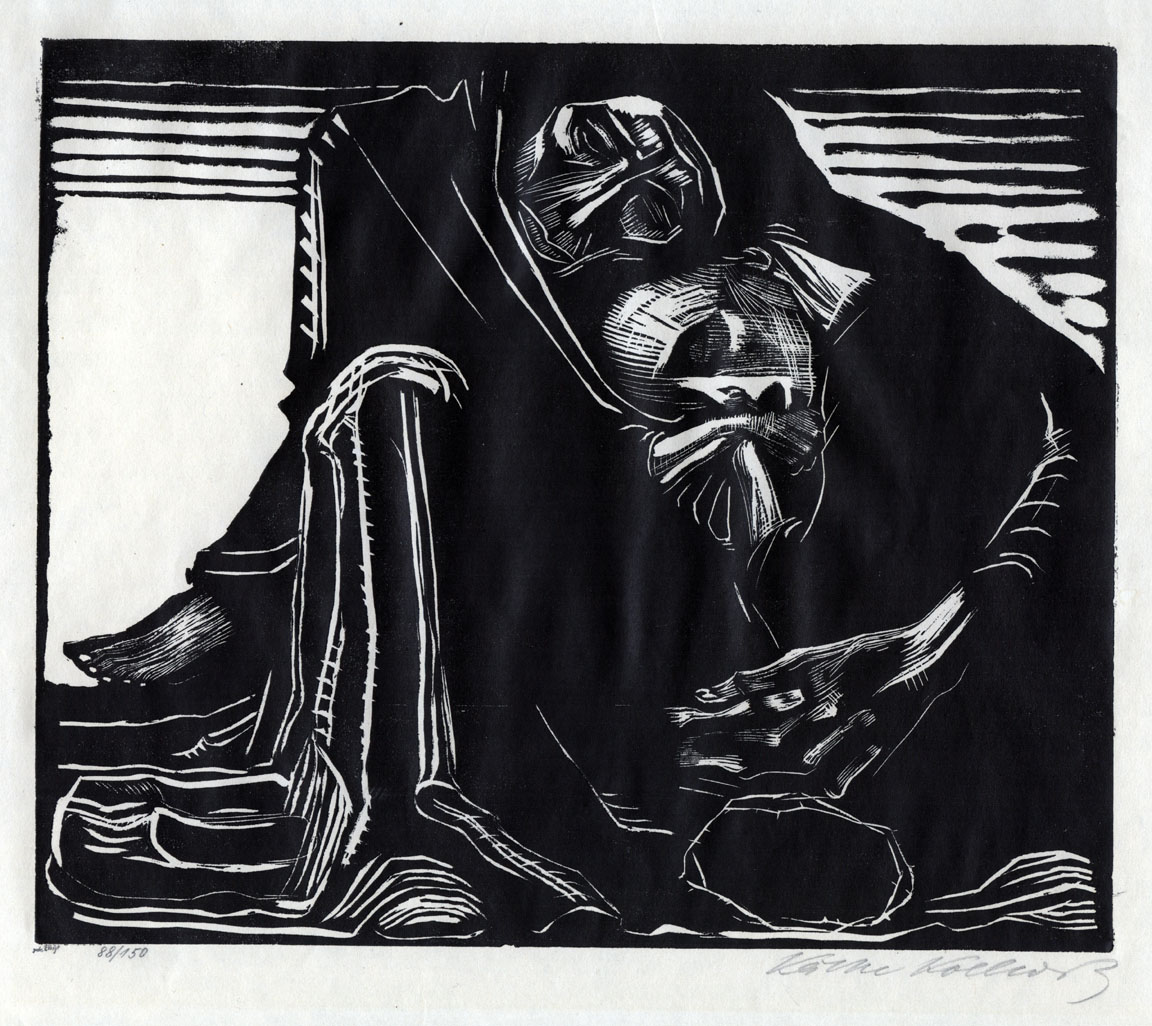
Like Ernst Barlach, I first discovered the works of KATHE KOLLWITZ when I was at the "Werkschule" in Koln, Germany, studying sculpture. I found her works moving, with simple lines that told passionate and often tragic stories. Amazingly enough, thirty years later I would wind up in Moritzburg, near Dresden, where I found the small museum that houses so much of her work.

Kathe (1867-1945) is regarded as one of the most important artists of the twentieth century, and as a remarkable woman who created timeless art works against the backdrop of a life of great sorrow, hardship and heartache.
Bread

Kathe was born in in Konigsberg, East Prussia (now Kalingrad in Russia). She studied art in Berlin and began producing etchings. In 1881 she married Dr. Karl Kollwitz and they settled in one of the poorest sections of the city. It was here that Kathe developed her strong social conscious which is so fiercely reflected in her work. In 1896 her second son, Peter, was born.

From 1898 to 1903 Kathe taught at the Berlin School of Women Artists, and in 1910 began to create sculpture.

In 1914 her son Peter was killed in Flanders. The loss of Peter contributed to her socialist and pacifist political sympathies. Kathe believed that art should reflect the social conditions of the time and during the 1920s she produced a series of works with the themes of war, poverty, working class life and the lives of ordinary women.

Death

In 1932 the war memorial to her son Peter - The Parents - was dedicated at Vladslo military cemetery in Flanders. Kathe became the first woman to be elected to the Prussian Academy of Arts, but in 1933, when Hitler came to power, she was expelled from the Academy . In 1936 along with Ernst Barlach, she was barred by the Nazis from exhibiting as her art was classified as 'degenerate' and her works were removed from galleries. Ernst Barlach was also an inspiration for her work. Alongside those of Barlach, her works number among the most moving artworks created during the 20th century. The kindred spirit demonstrated by the work of Ernst Barlach and Käthe Kollwitz is unmistakable.

Woman with Dead Child

In 1940 Karl Kollwitz died. In 1942 her grandson, Peter, was killed at the Russian front. In 1943 Kathe's home was destroyed by British bombing and she was evacuated from Berlin to Moritzburg, near Dresden, where she lived her final months as a guest of Prince Ernst Heinrich of Saxony.

The spirituality expressed in Kollwitz’s work was a result, as it was with many of her contemporaries, of the feelings of desperation aroused by the neediness and sorrowful state of the impoverished population.Yet she could also show the tender, loving side of motherhood.

Child's Head on Mother's Arms

Kathe made a total of 275 prints, in etching, woodcut and lithography. Virtually the only portraits she made during her life were images of herself, of which there are at least fifty. These self-portraits constitute a lifelong honest self-appraisal; "they are psychological milestones".

When I was at our Abbey in the east, I was befriended by the woman whose gallery (Galerie St. Etienne) was responsible for bringing Kathe's work to the USA.  At one point I even considered using one of Kathe's drawings for my final profession card.
 
The drawing I almost used!

Of all the artists exhibited at the Galerie St. Etienne over the course of its seventy-year history, Käthe Kollwitz has been most closely associated with the gallery's co-director, Hildegard Bachert. Hildegard Bachert was with Galerie St. Etienne  for 70 years. She is co-director with Jane Kallir (founder Otto Kallir's granddaughter). Hildegard came to New York in 1936 at the age of 15, fleeing Nazi Germany and went to work for Otto Killir right out of high school.

Hildegard and I not only share the name of a great German saint, but also the love of a great German artist.  In 2010 to celebrate her 70th anniversary at the gallery, Hildegard selected a group of Kathe Kollwitz self portraits for an exhibition subtitled “ A Portrait of the Artist.”


The first book I bought of her life & works


Saturday, May 4, 2013

GERMAN SCULPTURE

Barlach with my favorite piece

Before I entered the monastery, I lived in Germany, starting in Koln and moving to the Black Forest, where I studied wood carving. Living in Koln in the late 60s was exciting art-wise as there was so much being restored from the massive bombings of WW II.  It seemed there was a church on every corner and one of my favorites to visit was the medieval Antoniterkirche.
Angel in Antoniter Kirche


The church served as a monastery of the Antoniter Order from the 14th century until 1802 when it was closed and remanded to the Evangelicals. The church became Cologne's first Protestant place of worship when it was again opened in 1805. In this famous church hangs an amazing sculpture by one of my favorite German artists ERNST BARLACH (1870-1938). He was a German expressionist sculptor, printmaker and writer.

A trip to Russia in 1906 was one of the greatest influences on him and his artistic style and is reflected in some of my favorite works. The powerful and folk-like design of his sculptures after  reflect the impressions of rugged farm-life and Russian folk art.

Mother & Child (my favorite)

Begging Woman (another favorite)
In WW I he volunteered as a medic, then  was drafted into infantry in December 1915. Only three months later he was discharged due to a heart problem. His participation in the war made him change his thinking and this changed his art. He created haunting monuments in wood and bronze, erected in churches across Germany, warning of the tragic consequences of war.


The essence of Ernst Barlach’s art lay in his ability to express his devotion to and love for his fellow human beings in drawings and sculptures. Marginal figures in society, the needy, the broken, the outcast, remained the focus of his art. In radical opposition to the fascist ideology of “community”, he addressed the existential loneliness of the individual.

While his favorite aspect of man was sufferings of humanity he also saw a lighter side as the singing man and laughing old woman.
Singing Man

Old Woman Laughing

Ernst Barlach’s work was an outcry of the oppressed yet his depictions also transported the spirituality and the  humanness of everyday people. He used emphatic gestures and angular poses to convey strong emotion and movement.  "I desire nothing more than to be an artist, after a fashion. It is my belief, that whatever cannot be expressed in words, can be passed on to another by means of forms.”

Obviously, such art created many conflicts during the rise of the Nazi Party, when most of his works were confiscated as degenerate art. You can be sure that anything banned by the Nazis, was real art!

In 1936, when Barlach's works were confiscated during an exhibition together with the works of  KATHE KOLLWITZ (Blog to follow). Barlach himself was prohibited from working as a sculptor, and his membership in the art academies was canceled. This rejection is reflected in his final works before his death from heart failure in 1938 in Rostock, Mecklenburg.


Monks Reading

What drew me to him was his ability to show contrast between spirit and body, between heaviness and lightness, between attachment to the earth and spirituality. My father, who himself was an artist/architect, could never understand my love for this "ultra- modern" artist. For me the depth of his sufferings are so easily conveyed in his works.

The Holy Family
Monk Reading

Today, Ernst Barlach is known as one of the most important sculptors of Classical Modernism.

Wednesday, May 1, 2013

IN MEMORIAM- A GREAT GERMAN ARTIST


Resurrection
The German artist EGINO WEINERT died September 4, 2012. He devoted his life to creating some of the most unique and distinct pieces of liturgical art for spaces of worship around the world including the chapel of the Pontifical Academy of Sacred Music in Rome (which Bl. Pope John Paul II said was among the most beautiful he had ever consecrated). Collectors everywhere value Weinert's strong biblical images. Egino Weinert created all of his pieces solely with his left hand after losing his dominant right hand as a young man.


I first encountered his work through Hildegard Letbetter at Creator Mundi in Denver. (Creator Mundi imports Religious Art from Germany, France, and Italy. It is the official US importer of art from the German Abbey of Maria-Laach.The Stations of the Cross in our Chapel come from ML.)  I used his St. Hildegard for my 25th jubilee card.  We all have medallions of his to put on the top of our coffins.  I have 2: one of St. Hildegard for inside and one of the Good Shepherd for outside.

St. Hildegard

Born on March 3, 1920, in Berlin to devout Catholic parents the eldest of five children, the young Günter Przybylski heard Romano Guardini  (considered one of the Catholic Churches greatest philosophers of the 20th C.) preach. It was to have a lasting effect on his deep faith.

While preparing to receive his first Communion he was greatly attracted to the priesthood and in 1934 entered the Benedictine abbey at Münsterschwarzach. There he received the name Egino (years later his father changed the family name to Weinert). Egino had wanted to be a painter and a missionary, and was gradually allowed to apprentice in sacred painting, passing his goldsmith’s examination with distinction in 1941.


Good Shepherd

 
Jailed for refusing to say “Heil Hitler,” Egino was later drafted into military service taking every opportunity to work with other artists during the difficult war years.  While visiting his parents in Berlin in 1945, he lost his entire right hand when an electrical fuse proved to have explosives hidden in it. He then taught himself to write and paint with his left hand. He returned after the war to the monastery and was finally sent to attend art school in Cologne. In 1949 he was refused final vows, leaving the monastery with his faith still intact, but alone in the world. 

In 1951 he married Anneliese Leopold and they had four children. Eventually he settled in Cologne near the cathedral, and built a house and studio where he did all of his art.


St. Francis
Commissions and honors gradually increased for the struggling artist. He was helped by the great popularity of the small crosses he made for children receiving Communion. His enamel designs proved to reproduce beautifully on cards and calendars. He delighted in crafting chalices for young priests and became popular with American visitors to his shop. Pope Paul VI admired a cup-shaped chalice that Egino told him the cathedral chapter in Cologne had considered unacceptable, but that the pope declared blessed through his own use.

"The continuity of Egino Weinert’s work, artistically and religiously, is remarkable. His simplified, sinuous forms recall Ernst Barlach (a future blog) and seem of themselves to demand the bold colors, dramatic and yet tender, of his unblended palette. His unerring sense of scale, indebted to medieval stained glass and Netherlandish primitives, enables him clearly to distinguish principal figures and onlookers in settings that are detailed but never crowded. 


Baptism of Christ
He has a miniaturist’s sense of intimacy and yet the elemental feeling of Georges Rouault, whom he has long admired. Perhaps the lovely miracle of his art has been possible because it has indeed been his mission. “I want to see the whole Bible with the eyes of our time and let it become plastic,” he says. “For me Christ is not an otherworldly figure floating over humanity in a long robe. He is in our midst as a simple farmhand or a cabinet-maker” - or as a good shepherd, as were generations of Egino Weinert’s ancestors." (Leo J. O’Donovan, S.J., is president emeritus of Georgetown University, Washington, D.C.) 


St. Joseph with Child

Monday, April 29, 2013

THE LAST EMPRESS

Zita   1911

We have considered Bl. Karl of Austria, now we look at his wife  Princess Zita of Bourbon-Parma (Zita Maria delle Grazie Adelgonda Micaela Raffaela Gabriella Giuseppina Antonia Luisa Agnese).  She was born in 1892, near Lucca, Italy. She was the seventeenth child of the dispossessed Robert I, Duke of Parma and his second wife, Infanta Maria Antonia of Portugal.

In 1911, Princess Zita married Archduke Karl of Austria, the great-nephew of Emperor Franz-Joseph. This union satisfied dynastic demands but it also represented a marriage between two people bound together by a profound love and nourished by the same Catholic faith.

Engagement
In 1914, the assassination of the Archduke Franz Ferdinand, Heir to the Throne of Austria-Hungary, left Karl in the position of Heir Apparent to the Emperor. In 1916, when Franz-Joseph died, the young Archduke (he was 29 years old) became Emperor Karl I of Austria, and King Karl IV of Hungary.

During the two years of his reign, from 1916 to 1918, Empress Zita stood by her husband’s side, supporting all of his initiatives.  At the same time, the couple led an exemplary life, marked by great piety and blessed by the birth of eight children.

Zita as Empress
After the end of World War I in 1918, the Habsburgs were deposed when the new countries of Austria, Czechoslovakia, Hungary and the Slovenes, Croats and Serbs States were formed.

By the fall of the next year Austria-Hungary was coming apart forcing Charles and Zita and their family to flee the country to Switzerland. Zita was a great source of strength and comfort to her husband in these hard times and the strain on her had to be great. In 1920 she showed again what she was made of when she accompanied Charles in his effort to regain his throne in Hungary. After both attempts failed the family eventually settled on the Portuguese island of Madeira where Charles died not long after. After her husband's death, Zita and her son Otto served as the symbols of unity for the exiled dynasty.


Zita & Karl with first 4 children
A widow at the age of 29, expecting a child that would never know her father and lacking any resources, Empress Zita started a long exile moving to Spain and later to Belgium. When Engelbert Dollfuss became chancellor of Austria the possibility of a restoration seemed good but all hopes were ended when Dollfuss was assassinated and Austria was occupied by Germany. World War II and the invasion of Belgium forced the family to flee to the United States where two of her sons joined the American army. Empress Zita contributed by raising money in the US and Canada.

She never remarried and carried on with the same grace and dignity she always showed, raising her children in royal fashion and never giving up hope for a Hapsburg restoration. In 1982 she was finally allowed to return to Austria where she died, still loved and respected by all, in 1989 at the age of 96. Her funeral was attended by 6,000 people, over 200 Hapsburg and Bourbon-Parma royals and a personal representative of Pope John Paul II.

Zita

On October 3, 2004, Pope John Paul II beatified Emperor Karl.  The Church assigned the celebration of the feast day of Blessed Karl of Austria to October 21, the day Zita and he were married.  The edifying life of Empress Zita, her unshakeable faith, and her moral strength in adversity make her a model of an exemplary wife and Christian mother.  Through her family ties that cross over international borders, Empress Zita is a symbol of peace among the nations. Her cause for canonization has been introduced.


Zita with her 8 children

Zita & Karl