Monday, June 15, 2020

MESSAGE FROM SEATTLE ARCHBISHOP- THE EUCHARIST


Our new Archbishop of Seattle, Paul Etienne, has written a magnificent pastoral letter- too long to put on this Blog- “The Work of Redemption: Eucharistic Belief and Practice in the Archdiocese of Seattle”, which I advise all to read, for it pertains to the whole Church.  Throughout the summer I will add parts to the Blog, for one can never have too much understanding of this doctrine which is central of our Catholic faith.


“The COVID-19 pandemic has impacted every aspect of our lives, including our worship. For us Catholics, the pandemic, along with the “Eucharistic fast” it imposed, has revealed in a new way how central the celebration of the Eucharist is to who we are as Church and as community. Even when we are unable to gather physically, we gather spiritually: Parishes continue to put the celebration of the Eucharist at the forefront of parish life through livestreams on social media. But we have also come to realize, perhaps as never before, that there is no substitute for gathering to celebrate the Eucharist together, and receiving the sacrament of Christ’s Body.”

“The Eucharist is an inexhaustible source of grace, the Paschal Mystery of Christ’s dying and rising daily renewed for our salvation and for the salvation of the whole world. The Eucharist is the living presence of Christ in our midst. That presence does not, must not leave us unchanged: Receiving the Body of Christ, we become the Body of Christ. The Eucharist unites us to Christ, and, in Christ, to each other. And the Eucharist commits us to the poor, sending us forth in service and love. When it comes to the Eucharist, we can always go deeper. No matter whether we have spent years exploring Eucharistic theology, or are still preparing for our first Holy Communion, there is always more to discover about the Eucharist. And no matter the resources of our parish communities, with care and attention our liturgies can always be improved, to reflect more clearly the Christ who truly presides at every celebration of the Eucharist. During the coming year, I ask every Catholic and every parish community to commit themselves to deepening our understanding and experience of the Eucharist, and strengthening our Eucharistic liturgies. In a spirit of encouragement, and with a desire for a more profound and visible unity around the altar of the Lord, I am sharing this pastoral letter on the Eucharist and declaring the coming year a special Year of the Eucharist for the Archdiocese of Seattle. I hope the following reflections will help provide a roadmap for the months ahead.”

Saturday, June 13, 2020

APOSTLE of MAUI


The next holy Hawaiian is, HELIO KOA’ELOA,  who was born in 1815 on Wailua ValleyMaui, Hawaii.

Wailua  Valley
He was living in Hāna  (one of my favorite places on earth) when he heard about the arrival of a new religion, Catholicism. He paddled a canoe to Honolulu to be personally instructed in the faith and to join the church. 


Photo of Hana 1888- not unlike when Helio or
I lived in the Islands
 Then he returned to Maui and instructed over 4,000 people for the Catholic Mission. At the time Catholics experienced discrimination at the hands of the Protestant majority. Unfortunately, his death came shortly before the Catholic mission in Maui was established. 

His boundless enthusiasm for the promotion of the Catholic faith earned him the title "Apostle of Maui". Before the Catholic Mission was properly established in Maui, Koa'eloa died in 1848 and was buried in Wailua, the valley of his birth.

Landmarks and memorials were dedicated to him at Maui. A cross (called Hâna cross) was erected in Wailua valley in his memory in 1931.

N.B.For those who have never traveled the road to Hana, it takes approximately 7 hours to complete and the Road to Hana is considered the 5th most dangerous road in the world. There is nothing but sharp, blind turns, one way roads, one car bridges on roads that  are often not wide enough for two cars. The road starts at Paia , extending some 42 miles, 54 bridges, and 600 hairpin turns.  Only five miles apart, Wailai Valley and Hanna, must have taken ages to travel in the 1800s, either by horseback or walking. continuously turn, though I supposed one could have paddled faster. You pass the turn off- if you could call it that, into the valley from the famous Hana Road.

Friday, June 12, 2020

PRAYER FOR HEALTHCARE WORKERS IN A PANDEMIC


On October 23, 1982, at the World Congress of Catholic doctors, St. John Paul II called on healthcare professionals to model their conduct on “Christ who was the doctor of the soul and often of the body of those He met on the roads of His earthly pilgrimage. This prayer is most appropriate, almost 40 years later, for our present day situation.


Lord Jesus, Divine Physician, who in your earthly life showed special concern for those who suffer and entrusted to your disciples the ministry of healing, make us ever ready to alleviate the trials of our brethren. Make each one of us, aware of the great mission that is entrusted to him, strive always to be, in the performance of daily service, an instrument of your merciful love. 
Enlighten our minds, guide our hands, make our hearts diligent and compassionate.

 Ensure that in every patient we know how to discern the features of your divine Face. You who are the Way, provide us with the gift of knowing how to imitate you every day as medical doctors not only of the body but of the whole person, helping those who are sick to tread with trust their own earthly path until the moment of their encounter with You.

You who are the Truth, provide us with the gift of wisdom and science in order to penetrate the mystery of the human person and their transcendent destiny as we draw near to them in order to discover the causes of their maladies and find suitable remedies.

You who are the Life, provide us with the gift of preaching and bearing witness to the ‘Gospel of life’ in our profession, committing ourselves to defending it always, from conception to its natural end, and to respect the dignity of every human being, and especially the dignity of the weakest and the most in need.


Make us, O Lord, Good Samaritans, ready to welcome, treat, and console those we encounter in our work. Following the example of the holy medical doctors who have preceded us, help us to offer our generous contribution to the constant renewal of health care structures.

Bless our studies and our profession, enlighten our research and our teaching.

 Lastly, grant to us, having constantly loved and served You in our suffering brethren, that at the end of our earthly pilgrimage we may contemplate your glorious countenance and experience the joy of the encounter with You in your Kingdom of joy and everlasting peace.
Amen.

Wednesday, June 10, 2020

ANOTHER MOTHER IN MOLOKAI


Our next Hawaiian is SISTER MARIA LEOPOLDINA BURNS (1855- 1942) who was a member of the Sisters of St Francis of Syracuse, New York, and a close companion and the biographer of St Marianne Cope.


Together with Mother Marianne and 5 other sisters, they departed from Syracuse to travel to Honolulu to answer the request of King Kalākaua of Hawaii to care for leprosy sufferers arriving on November 8, 1883.  The trip from New York to the boat in San Francisco, reads like a fictional travel log.

They traveled on the SS Mariposa. With Mother Marianne as supervisor, the Sisters' task was to manage Kakaʻako Branch Hospital on Oʻahu, which served as a receiving station for Hansen's disease patients gathered from all over the islands. The more severe cases were processed and shipped to the island of Molokaʻi for confinement in the settlement at Kalawao, and then later at Kalaupapa.

In 1889, together with Mother Marianne and Sister Vincentia McCormick, they opened and ran a girls' school in Hawaii, which they named in Henry Perrine Baldwin's honor, a prominent local businessman who supported their missions.

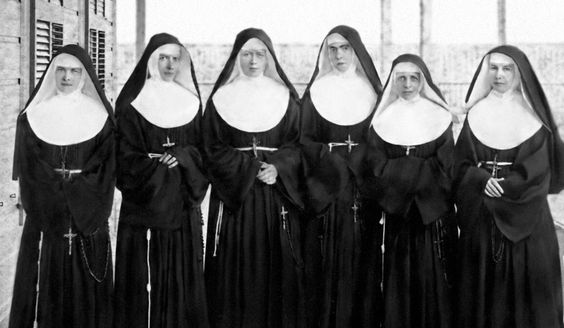
Sr. Leopoldina 3rd from left, M. Marianne far right.

 
After serving for nearly 40 years on Molokai, Sister Leopoldina retired in 1928 to the St. Francis Convent in Manoa Valley  (where I lived when in Hawaii, often attending daily Mass at the small convent chapel still run by the sisters) )where she lived until her death.

 Sister Leopoldina died on June 3, 1942 with the reputation for holiness. She was the last of the Catholic sisters to serve alongside Father Damien.


The definitive biography of Mother Marianne, Pilgrimage and Exile (aka "Song of Pilgrimage and Exile") written in 1982 and later updated was founded primarily upon manuscript sources, reads like a novel.  The whole adventure of the sisters at times is like something out of Indiana Jones, filled with mystery and intrigue.

The Journals of Sister M. Leopoldina Burns are undated, although apparently they were begun in the 1920s at the direction of Sister Flaviana.  Both an original set of notebooks and a rewriting of the same with more development of incidents are extant.  In the latter set there are 56 chapters in 15 notebooks.  Sister Leopoldina also wrote a Little History of Mother Marianne’s Work which contains selections from the journals.

In 1980, Bishop John Scanlan of Honolulu appointed a historical commission, along with consultants, to collect all available documents concerning Mother Marianne, especially her writings, for submission to Rome, a major step toward her beatification. Pilgrimage & Exile, the fruit of this careful research, is the inspiring story of  St Marianne and her sisters who lived lives of extraordinary dedication, sacrifice, and faith. St. Marianne is called "beloved mother of outcasts," but the same title could be for the others sisters, including Sister Leopoldina.

*  Written by one of the sisters from the order of St. Marianne and Sr. Leopoldina  and O.A. Bushnell, a professor at University of Hawaii.  See Blog  4/1/2016

Monday, June 8, 2020

A NEW CHURCH FOR OUR TIMES

Odon Czintos- Hungary


Bishop Mario Grech Administrator of Gozo and Pro-Secretary for Synod of Bishops wrote the following to the clergy of his diocese, “one would be committing suicide, if, after this pandemic, one were to return to the same pastoral models.” This reflection arises from the recent challenges and limitations for pastoral work during the COVID-19 pandemic. L’Osservatore Romano and Vatican News report that this crisis “… has shaken foundations we thought were immovable, as we have seen in the economic sector, in science, and in politics.” This unprecedented situation also involves the Church. “Pope Francis – observes Grech – continues his appeal regarding the need for pastoral conversion.” Bishop Grech adds that we have become more aware of this need for conversion during the pandemic, as we have been immersed in new “experiences that prompt us to contemplate the face of Christ.”

Bishop Grech warns against reducing the pastoral activity of the “church to the sacristy, away from the streets, or simply being content to projecting the life of the sacristy on to the streets.” He observes that during these last few months of isolation, suffering, and pain we are presented with “an opportunity (a kairos) for renewal and pastoral creativity,” that demonstrate to us the reality that we cannot return “to the practices that limited us before the pandemic.” A time that revealed in certain Christians, consecrated and lay, “a strong pattern of clericalism.” Bishop Grech cites the words of the famous French author Georges Bernanos regarding ‘rotten Christianity.’ “One asks, how is this profession of faith meaningful – if then this same faith does not become leaven to transform the dough of life?”

From this perspective, Bishop Grech moves to the idea of the ‘domestic church’ that has been revitalised and experienced in a new way during this lock down. He observes that a certain clericalism since the fourth century has worn away at the “nature and charism of the family in as much as it is the domestic church.” One finds a restoration and development of the theology of the domestic church during Vatican II, especially in Lumen Gentium paragraphs 10 and 11. Bishop Grech remarks that “just as in the first centuries, the family today can become again the source of Christian life.” Moreover, “in as much as the basic structure of the Church is sacred and liturgical, one must also revive their place in the family as the domus ecclesiae.” Drawing upon the insights of Augustine, John Chrysostom, as well as Jewish culture, “the family should be a place where faith is celebrated, reflected upon, and lived. 

Women Praying- Vladimir Dimitrov- Bulgaria
The parish community must help the family to be a school of catechesis and a classroom of liturgy where one might break bread at the table of the family home. Parents, by virtue of the grace of the sacrament marriage, are ‘ministers of this worship’ wherein the home, they break open the Word and pray with the Word, so as to transform the faith of their children.” Bishop Grech hopes that the Lord may multiple many examples of families’ “creative in love,” who are ready “to create spaces for prayer in openness to the most poor and needy in our midst.” Equally important after this pandemic will be the “ministry of service,” the diakonia as a ‘new’ path for evangelisation. “One cannot celebrate the breaking of the Eucharistic Bread and of the Word, if one does not share with the ‘poor who are theologically the face of Christ.’” Service or diakonia “is the sure way to experience Christian love. One communicates the Gospel not only by preaching but also in service. The Church reaches people not only through catechesis but also through the experience of diaconal service. As the Pope says, if we move amongst the poor, we will discover God.”

Bishop Grech shares a letter written to him by a humanitarian worker after the rescue of a group of migrants at sea with the help of his diocese. “Unfortunately, I often witnessed in the past incomprehension between the Church and people, as well as from non-Christians of goodwill. Today things are changing and now they feel that the Church is a friend who hears the cry of the poor and seeks to come to their aid.”

Kathe Kollwitz- Germany

In this ‘change of times,’ according to Bishop Grech, “the contribution that the Church can give, or rather must give, is the proclamation of Jesus Christ to the world and the joy of the Gospel.” This contribution can be understood in light of Pope Francis’ Christmas Greetings to the Roman Curia, 21 December 2019. Pope Francis notes that in Europe and throughout much of the West, the Christian faith lives in a new era. “We find ourselves living at a time when change is no longer linear, but epochal.  It entails decisions that rapidly transform our ways of living, of relating to one another, of communicating and thinking, of how different generations relate to one another.” 

Bishop Grech takes up the thought of De Lubac as found in his book, The Drama of Human Atheism. “It is not true, as it is sometimes said, that man cannot organise the world without God. What is true is that, without God, he can only organise it against man.” Likewise, this global pandemic reveals that at times, “economic and financial interests have been given precedence over the common good.” This dynamic must be corrected.


Kathe Kollwitz- Germany 
In his conversation with Vatican media, Bishop Grech focuses on the “gift of synodality as a way of ecclesial life,” a gift given to the Church by the Holy Spirit. “The synodal path – affirming the call of Pope Francis – is the path that God expects of the Church in this third millennium. As a dynamic of communion, synodality is above all, the affective integration of all participants, in a spirit of dialogue, so that all might arrive at a point of consensus… Although synodality belongs to the ecclesial vocabulary, it has value for society in general. Adapted as a working principle for the secular world, synodality could be a style of collaboration for inter-personal relationships and human fraternity. Synodality is an antidote against isolation that helps us to appreciate the beauty of the human community. Walking together is not always an easy task, be it for the Church or for society, but all of us need to exercise this practice so vital for the future.” Looking ahead to the next synod and the theme of synodality, Bishop Grech hopes that there “will be reflection on synodality before the celebration of the Synod itself so that the Synod Fathers might offer a deeper contribution to this theme.”


            Adapted and translated from the article in L’Osservatore Romano (by Alessandro Gisotti )

Friday, June 5, 2020

APOSTLE OF HAWAII


As readers of this Blog know, I am  very fond of Hawaii , especially its "holy people”. Our Oblate, whom I stay with on the Big Island, is here with her, soon to be off to college daughter and two of her friends, to help us out for the month.  So it is fitting that I present some recently  discovered  people who are being considered for sainthood, one my pastor when I lived in Hawaii (Oahu) many years ago. The first, should be more widely known, especially by his own people, the Hawaiians.

FATHER ARSENIUS WALSH, SS.CC., (1804 – 14 October 1869), was an Irish Catholic priest who was among the first Roman Catholic missionaries in the Kingdom of Hawaii. He was a member of the Congregation of the Sacred Hearts of Jesus and Mary, the same order as St. Damien of Molokai. He is called the Apostle of Hawaii.

The first members of his congregation had arrived in Honolulu, Hawaii, on 9 July 1827, under the leadership of Father Alexis Bachelot, SS.CC., named the first Prefect Apostolic for the region by the Holy See. The Picpus community, composed of both priests and lay brothers, soon began to gain converts among the Native Hawaiians


This quick success, however, sparked the opposition of  the  Congregationist missionaries who had arrived from the United States several years earlier and who had been embraced by the chiefs of the kingdom. Encouraged by the Protestant clergy, the chiefs passed laws which imposed heavy penalties, such as forced labor, beatings and imprisonment on their people who embraced Catholic practice. This led to a Catholic underground where the two French priests had to care for their new flock by presiding over private Masses in darkened homes and had to offer catechetical instruction for new converts in secret. The chiefs expelled the priests of the community on Christmas Eve 1831, having them transported to Lower California in Mexico, but allowed the lay brothers to stay. The priests were taken in by the Franciscans there and served at the California mission.

An Irish seminarian in the Hawaiian community, Brother Columba Murphy, SS.CC., still a layman in the eyes of the government, made frequent visits to the mission, continually appraising the situation for the Fathers in Mexico. By the mid-1830s, the political climate in Hawaii had changed. Brother Columba went to Monterrey to encourage the two priests to return. Unable to locate them, he left a message advising them that the time was ripe. In response to this, Father Walsh was sent to Hawaii.

Father Walsh, who might have been born Robert Walsh, a given name often ascribed to him, arrived in Hawaii on 4 September 1836 and established himself with the lay brothers of his congregation. His expulsion was urged by the Protestant clergy, who had the king's ear. Unlike the other Picpus Fathers,  (the orders other name  because their first house was on the Rue de Picpus in Paris, France)however, he was a British subject, and gained the support of the British consul in Hawaii, whose favor was being sought by the kingdom. Consequently, he was permitted to stay, on the condition that he not engage in any proselytization of the native people.


Encouraged by his presence and changes in the island leadership, the two French priests returned to Hawaii the following year. They were joined by another priest of the congregation, Louis Désiré Maigret, who had been appointed as the first Vicar Apostolic of the Sandwich Islands. Opposition and persecution continued, however, and Father Maigret and another French priest had to leave that following December.

Religious persecution eventually ended after the arrival of a French frigate, L'Artémise,  captained by Cyrille Pierre Théodore Laplace, in the process of circumnavigating the world. He had been given instructions by the French government to protect the French residents of Hawaii and to ensure the free exercise of the Catholic faith. Laplace presented King Kamehameha III with an ultimatum, demanding these steps with a monetary surety for compliance, otherwise threatening bombardment of the island. Consequently, the king issued the Edict of Toleration, which led to the free practice of the Catholic Church in Hawaii.

In 1841, with the successful establishment of a congregation in Honolulu, Father Walsh was sent to establish a mission on the island of Kauai, a recently conquered island in the kingdom. He landed on 22 December and was given a warm welcome  the islanders.  He celebrated the first Mass on Christmas Day, under a tree in the village of Koloa, by which he inaugurated the Mission of St. Raphael. He then began classes of instruction in the faith and opened a school at the mission, following which he set out on a tour of the island to expand his mission to the surrounding population. He was able to have a small chapel built on the site by the following March.

St. Raphael
On this island, however, Father Walsh encountered the same hostility and persecution which had taken place on Oahu. The chieftess of the island, Amelia Kekauonohi, was a staunch Protestant, and, while not taking any open steps, did not interfere when lower chiefs would imprison and impose heavy penalties on those who established ties with the mission. Father's energy was thus divided between preaching the Gospel to the populace and defending his followers against the local chiefs.

Despite this opposition, and the eventual failure of some of his missions on the island, Father Walsh spent the next six years establishing churches and schools around the island, including the St Raphael Catholic Church, which began in 1843.

He even extended his mission to the island of Niihau  celebrating the first Mass there on 31 July 1842.  He returned to Oahu either in 1848 or in 1859,  where he became the pastor of Ahuimanu. It was there that he died on 14 October 1869.

Sunday, May 31, 2020

MOTHER OF OUR CHURCH


Last week we celebrated the feast of Pope Saint Paul VI, which is listed as a memorial ad lib- which means we can celebrate it if we want, or not.  But for us this Pope had a significant influence on our foundation to the USA in the 1940s, so we celebrated it as a full memorial.  In 1960 he gave us Lumen Gentium (Light of the Nations),  one of the principal documents of the Second Vatican Council.  It is not coincidental  that we celebrate his feast so close to the new feast of MARY, MOTHER OF THE CHURCH.


Elly Tulis- Indiana
“At once virgin and mother, Mary is the symbol and the most perfect realization of the Church: ‘the Church indeed… by receiving the word of God in faith becomes herself a mother. By preaching and Baptism she brings forth sons, who are conceived by the Holy Spirit and born of God, to a new and immortal life. She herself is a virgin, who keeps in its entirety and purity the faith she pledged to her spouse”.

So why has the Church put this new feast the day after Pentecost? Mary was with the Apostles when the Holy Spirit descended upon them on that very first Pentecost!  Christ gave His Mother  to us as our Mother, so she is the spiritual mother of the Church. 

“The hope is that the extension of this celebration to the whole Church will remind all Christ’s disciples that, if we want to grow and to be filled with the love of God, it is necessary to plant our life firmly on three great realities: the Cross, the Eucharist, and the Mother of God. These are three mysteries that God gave to the world in order to structure, fructify, and sanctify our interior life and lead us to Jesus. These three mysteries are to be contemplated in silence.”
                                                                                                    Cardinal Robert Sarah

“God’s plan included providing a Savior who entered this world through a dual choice: God chose Mary and Mary chose God. The Church honors Mary because she is the beloved Mother of Jesus. Mary was part of God’s plan for salvation. As the Mother of God and as the Mother of the Redeemer, she maintains a place of honor in both the earthly Church and in the heavenly.

Her relationship is distinct from all other humankind, because she was born sinless. Mary was completely human, born without sin and remained sinless. By nature of her humanity she required salvation. Mary’s role was not forced on her; she was completely free to say yes or not. Jesus restored grace to the world. Mary participated in this by her loving cooperation with God. Mary played an integral part in God’s plan to save the world.

She was present and devoted to Jesus as his mother and supported him in his ministry from Cana to Calvary. After his death she remained present in prayer and faith. Our devotion to Mary is out of love and respect to God and His plan. It does not and is not intended to diminish the truth that Christ alone is our mediator. Mary is a great helper to us as we seek the road to holiness. She was human and as such was forced to face temptation. She did not cave in to temptation but endured in all things.

She is the model of virtue. By meditating on her, we grow more like her Son. We honor and have piety toward Mary for no other reason than to better know Christ and to open the whole world up to receiving the graces of Christ. The Second Vatican Council encouraged people to cultivate a loving devotion to Mary and strongly urged theologians and pastors to abstain from gross exaggerations and or neglectful omission in considering the dignity of Mary.

Mary’s place is with God in heaven. Christians are called to understand as Mary did, that in the end truth will prevail, as all things are restored in Christ. The Fathers of the Second Vatican Council provide us with a great.”  (Lumen Gentium)