Monday, May 3, 2021

LORD OF THE DANCE


Most of us know and love the hymn “LORD of the DANCE”. And if we don’t know the hymn we certainly know the dancing of Michael Flatley, who brought to life this grand music in his "Riverdance". 

Dance, then, wherever you may be,
I am the Lord of the Dance, said He,
And I'll lead you all, wherever you may be,
And I'll lead you all in the Dance, said He.

Amazingly enough, it is not an old Protestant hymn, but the work of an English song writer,  Sydney Carter.  He wrote the hymn in 1963 setting it to the melody  from the American Shaker song "Simple Gifts".

The song follows the idea of the traditional English carol "Tomorrow Shall Be My Dancing Day", which tells the gospel story in the first-person voice of Jesus of Nazareth with the device of portraying Jesus' life and mission as a dance.

As I watch lambs gamboling in the pasture, I  think of how as Christians we should be dancing for joy after the Resurrection.  Never mind pandemics and the losses it has brought us, but rather look to what we have and dance in our hearts, knowing all will be well, thanks to  our resurrected Lord.

They cut Me down
And I leapt up high;
I am the life
That'll never, never die;
I'll live in you
If you'll live in Mme -
I am the Lord o
f the Dance, said He. 

This theme of the dancing Lord is not a new one. I am not going to get into the history of dance- or lack of- in the Western Church's liturgy, but  it is very prominent in other cultures, such as in Africa. It certainly was in Jesus background, and even though not mentioned, He must have known dancing in His day.

Dancing in Jewish tradition was one of the ways to praise God’s name. (Psalm 149:3, 150:4). From the Jewish perspective, you stop dancing when joy has gone from your hearts (Lamentations 5:15). God is the one who can turn our mourning into joy and dancing (Psalm 30:11)

 It was truly a gift from Yahweh, “dance functioned as a medium of prayer and praise, as an expression of joy and reverence, and as a mediator between God and humanity.


The people were encouraged to praise God with 'dancing, making melody to Him with timbrel and lyre' (Psalm 149:3), and to 'praise Him with timbrel and dance' (Psalm 150:4),  and this understanding of dance permeated the faith of the early Christian church. The children of Israel would hold religious festivals, celebrations for triumphant victories, weddings, and dance was an essential part of the celebrations of the ancient Israelites. 

What started this whole thought of the Lord dancing was a mural I recently came across.  The Dancing Saints icon is in St. Gregory of Nyssa’s Episcopal Church in San Francisco created by artist Mark. Completed in 2009, it wraps around the entire church rotunda, showing ninety larger-than life saints and a twelve-foot tall dancing Christ.

The saints, ranging from traditional figures like King David, Teresa of Avila and Frances of Assisi to unorthodox and non-Christian people like Malcolm X, Anne Frank, and Margaret Mead, represent musicians, artists, mathematicians, martyrs, scholars, mystics, lovers, prophets and sinners from all times, from many faiths and backgrounds.

Richard Fabian, St. Gregory’s Co-Founder says “Gregory of Nyssa’s commentary on Psalm Fifty gives us his vision of the world’s peoples in harmony− not just audible harmony, but active dancing harmony. While other ancient preachers decried popular dancing, and music in general, as dangerously libidinous, Gregory of Nyssa and his friend Gregory Nazianzen extolled its use in worship.”

As we emerge from a pandemic which has put so many into darkness, the joy these holy dancers exude, should be our joy at this season of spring and resurrection!


Dance, then, wherever you may be,
I am the Lord of the Dance, said He,
And I'll lead you all, wherever you may be,
And I'll lead you all in the Dance, said He.


Friday, April 30, 2021

ABANDONED


                                                   St. Lucy finding Light in the Darkness

As we all suffer the on-going effects of this pandemic, which has ravished our lives, I find more and more people questioning their faith- faith in themselves, faith in government, faith in all they once held true, and faith in God.  This is not a bad thing, as sometimes doubt can lead us to what is real in our life. 

Even the greatest saints doubted. Look at St. Thérèse of Lisieux, a new doctor of the Church, and one of the most prayed to saints in modern times.

“He permitted my soul to be invaded by the thickest darkness, and that the thought of heaven, up until then sweet to me, be no longer anything but the cause of struggle and torment. This trial was to last not a few days or weeks, it was not to be extinguished until the hour set by God himself and this hour has not yet come. I would like to be able to express what I feel, but alas! I believe this is impossible. One would have to travel through this dark tunnel to understand its darkness.”

I think an artist once said, the greater the light, the greater the shadow. Even though we may feel alone, abandoned, at a loss for meaning in our life, there is the Light given to us by the Father- His only Son-  and given to us in the Eucharist- a gift beyond comparison. And what separates us from the saints, is the ability to carry on in spite of darkness.

I think also of the great St. Teresa of Calcutta.  Who knew that for most of her religious life she knew darkness- doubt- yet she carried on caring for the most wretched of people. 

She felt so abandoned by God that she was unable to pray and was convinced, despite her ever-present smile, that she was experiencing the “tortures of hell.” For nearly 50 years, Mother Teresa endured a “dark night of the soul” – a period of spiritual doubt, despair and loneliness that many of the great mystics experienced.  

“There is so much contradiction in my soul. Such deep longing for God, so deep that it is painful, a suffering continual, and yet not wanted by God, repulsed, empty, no faith, no love no zeal... Souls hold no attraction. Heaven means nothing, to me it looks like an empty place. The thought of it means nothing to me and yet this torturing longing for God.”

                                                    Lukewarm 

Where are you,

Fires that once burned bright?

Your flickering tongue

Of hot orange light

Has coiled back into

The closed mouth of night.


Winter rains continually drench,

Autumn’s glowing embers they quench,

And leave passion’s coals in smoky stench.


And what of the heart

Hope used to ignite?

It gropes for direction,

Too cautious to excite,

And too exhausted

To put up a fight. 


So I wonder if faith is real,

And why my emotions just won’t feel.

The same patent answers have lost their appeal.

Rob Wilson, OLR Oblate

Saints tell us  that we must enter into that dark night in which it seems we are losing our faith, if we are to hear the voice of God. Faith is nothing more than “unseeing”. Remember Jesus told Thomas, “blessed are they who do not see, but believe”. 


 Images:  St. Teresa- Chas Fagan

        left: Elizabeth Wang - Even in the Darkness...  


Wednesday, April 28, 2021

REMEMBERANCE


Remembering that our Seattle Archbishop, Paul Etienne, proclaimed from Corpus Christi 2020 to the same feast 2021, a Year of the Eucharist, here are some reminders for all:

“As we take a year to renew our life as Church that is so fundamentally rooted in the Eucharist, I am asking each member of this local church to an intensified renewal of prayer and study so that we may renew our belief in the true presence of Christ in the Blessed Sacrament as well as grow in our understanding of all that is contained in the most holy Mystery.”

Recently, Cardinal Giovanni Battista Re, Dean of the College of Cardinals spoke of the importance of the Eucharist in our lives, especially in these on-going days of pandemic.

“The Eucharist is the center and life of the Church. It must also be “the center and heart of the life of every Christian as well.

Those who believe in the Eucharist never feel alone in life. They know that in the dimness and in the silence of all the Churches there is Someone who knows their name… And before the tabernacle, everyone can confide whatever is in their heart and receive comfort, strength and peace of heart.

However, “we must continue to pray with our thoughts and our hearts filled with gratitude for Jesus Christ, who wanted to remain present among us as our contemporary under the appearances of bread and wine.

In the face of the pandemic, we are also encouraged to “raise a huge chorus of prayer so that the hand of God might come to our aid and end this tragic situation that has worrying consequences in the fields of health, employment, economy, education, and direct relationships with people."

As Christ Himself taught us, “it is necessary to go and knock loudly on the door of God, the Father Almighty”

Monday, April 26, 2021

TRANSFORMING ART

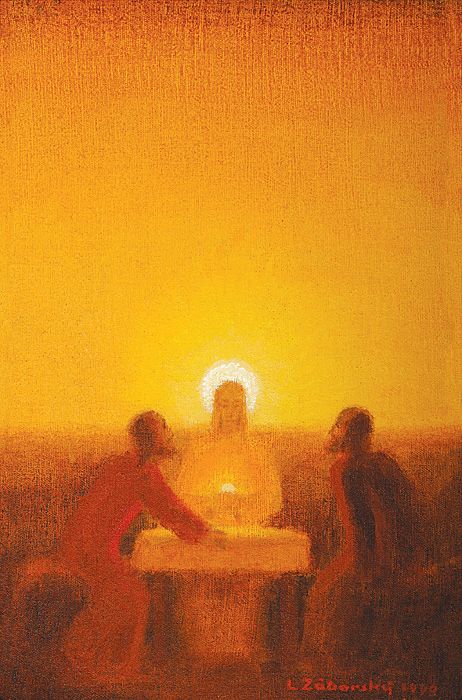
A fascinating story of an artist who found his voice in the worst of circumstances. As we celebrate the Easter  mystery, here is a story of a man who knew what death and life were about. 

LADISLAV ZABORSKY, a Slovakian artist who was imprisoned  for his work, was born in 1921 in the small town of Tisovec. He studied at the grammar school in Banská Bystrica where his drawing teacher Krákora took notice of him and recommended him for further studies.

Then he attended the Slovak Technical University in Bratislava, the Department of Drawing and Painting where such personalities as Ján Mudroch, Gustáv Mallý and Martin Benka taught him.

After finishing university studies he acted as a drawing and descriptive geometry teacher at the grammar school in Martin. He used to tell his students about his faith. Eventually, he was arrested for his religious activities. His crime? He painted Christ as a worker in 1949.  His other religious art was labeled corrupt Though there was given no accusation or judgment in his case, he was sentenced to seven years of imprisonment.

 He experienced interrogation, intimidation, demanding prison conditions and threatening, too. He spent five months in solitary confinement where he wrote thirty poems depicting his feelings and talks to God. Every event that had touched him somehow later appeared in his work and his work was often influenced by the gospel.

While imprisoned, Ladislav felt as if his hands were nailed to the cross because he could not paint but could only seek God in the depths of his soul.  He felt as if he was crucified because he could not walk where he wanted to. In poems written after his release, Ladislav expressed the deep spiritual transformation which occurred during his imprisonment. The result of his inner crucifixion meant he no longer fulfilled his own desires but only sought God and His will.

“God has saved me many times. He was really merciful to me. He turned all my difficulties, illnesses, even my imprisonment into great spiritual values. He is able to turn human muck into spiritual treasure.”

After serving half of his sentence, he was released on Christmas Eve 1957. In 1958 he created one of his most famous paintings, "Descent from the Cross", which symbolized his coming back from the “cross”, the prison.

When he was finally released, he was still affected by the consequences of persecution; he wasn’t able to get involved in society and his employment opportunities were minimal, thus he illustrated books for children and applied his mind to landscape painting.

During the period of normalization he decorated 25 churches with the Stations of the Cross. Between years 1968 and 1969 he lived in France with his family and studied sacral art - architecture and interior decoration of churches. His mission in life was to spread joy, Christian optimism and religious belief in eternal life.

Ladislav and his wife Gabriela, who stood faithfully by his side, had three children: Vladimir, Terezia, and Mary. 

“It was hard for my family. My children were between two and seven years old when I was imprisoned. My wife, a French and Latin teacher, had to work at night as a charwoman. She used to spend the whole day with our children and during the night, she was cleaning the orphanage for five hundred crowns per month. She spent only a couple of hours there. It wasn’t possible to live on it. If there hadn’t been good people who helped them, they would have died of hunger."

 He died in 2016 at age age of 95.


Light was the central theme of  his art,  not only the light that floods the landscape, or the light that is hidden in the soul of a man, but the Light that is permeates our life journey.  His paintings are  bright, yet  almost mono-colored - either bright orange, or deep blue.

“The substance of my work is the experience of God transferred into my heart (…) Art that seeks truth and beauty is the anticipation of eternity.”


My hands were crucified,
I cannot do what I like.
My legs were crucified,
I cannot go where I want.
Thus was I likened
to Your Son,
so that in me might be born
a new person
who will not fulfill his own desire,
but who seeks Your desire.
Hence I am suspended on this cross,
but salvation quickly approaches me.


~ By Ladislav Záborský (poems written from prison)
translated from Slovak by Harold B. Segel


Friday, April 23, 2021

A PEOPLE REMEMBERED


The U.S. bishops’ conference issued a statement on Monday recognizing the upcoming anniversary of the Armenian genocide.

“April 24 is Armenian Genocide Remembrance Day, marking the 1915 start of a campaign that resulted in the death of as many as 1.2 million Armenian Christians -- victims of mass shootings, death marches to distant camps, torture, assaults, starvation, and disease,” stated Bishop David Malloy of Rockford, chair of the USCCB’s international justice and peace committee.

Thousands of Armenian children were torn from their families and forcibly converted. “This horrific tragedy was intended to eliminate the Armenian people and their culture in what has been called the ‘first genocide of the 20th century.

Over the span of eight years, the Ottoman Empire targeted the mostly Christian Armenian minority for mass displacement, family separation, death marches, mass shootings, starvation, and other abuses. An estimated 1.5 million Armenians were killed in the genocide.


Turkey has historically denied that the genocide took place, claiming that the number of Armenian deaths was lower than estimated, and that many deaths were due to the First World War.


In April 2015, Pope Francis called the genocide one of “three massive and unprecedented tragedies” of the 20th century. In 2016, he prayed for peace following his trip to Armenia. “A people that suffered so much throughout its history, and faith alone, faith has kept this people on its feet.”


In a common declaration in 2000, Pope St John Paull II and Supreme Armenian Patriarch Karekin II also recognized the genocide.

“The extermination of a million and a half Armenian Christians, in what is generally referred to as the first genocide of the twentieth century, and the subsequent annihilation of thousands under the former totalitarian regime are tragedies that still live in the memory of the present-day generation,” the declaration stated.

A genocide denied is a genocide repeated!

Why do I bring this all up?  As sad as it may be, and a period in history that did not effect my family directly, my mother, the best cook I ever knew,  grew up in Fresno with displaced Armenians who came to this country for a better life.  She literally learned to cook some of my family’s favorite dishes from her neighbors.  One was the daughter of a world class cook, whose cookbook, written over 70 years ago, I still have and use.

I am speaking of GEORGE MAGAR MARDIKIAN (1903- 1977) who opened Omar Khayyam's restaurant in San Francisco, in 1938. He was a nephew of  Armenian revolutionary Krikor Amirian

His small cookbook gives a glimpse of the man and his love for his country.  Who in the US in the 40s and 50s ever heard of yogurt, but he says if you need it for one of the recipes, go to the phone book and look up a name that ends in "ian", and knock on their door with cup in hand!   

One of my favorite meals, and the one my mother always made me when I returned home for college breaks, was his lamb shanks.  My two brothers and I would walk a mile for a good piece of lamb and my last thanksgiving at home with all the family included this lamb dish, along with the turkey.

But back to this great cook.

George’s father, Magar, was of one of the approximately 250 ethnic-Armenian intellectuals and community leaders arrested on April 24, 1915, known as Red Sunday. After his arrest, the Amirians were driven out of their homes and marched to Erzincan. George's maternal grandmother, Vartanoush Amirian, committed suicide by jumping in the Euphrates, while the rest of the Amirian family was either beaten to death or burned alive. Witnessing the massacre of his mother's side of his family, George wanted to avenge their deaths. He ran away from home and joined the Armenian volunteer units, in which his uncle, Krikor Amirian, was a high-ranking member. After the First World War ended, George returned as a war hero.

Due to on-going political chaos, George’s mother told him to flee to the America and join a sister already there.  He arrived at Ellis Island on July 24, 1922. When he was able to take a shower, he stated, "I washed away the grime, I washed away the years. I washed away the Old World, I washed away all the hatred and injustice and cruelty I had known, all the hunger, all the weeping, all the pain”.

He later stated, "As I dried myself with the thick, heavy towel, and saw my clean skin and felt my blood tingle, it was as though I had been reborn, as though I were a completely new human being, a taller, a stronger, prouder man- an American”. From  that day, he proclaimed July 24 as his birthday.

He took the train to San Francisco and found a job working as a dishwasher at Coffee Dan's and later at Clinton's Cafeteria. He was later appointed restaurant manager by Eugene Compton.

In 1930, he moved to Fresno where he joined the vibrant Armenian immigrant community. He opened a lunch counter called "Omar Khayyam's", named after the famous Persian poet. He both cooked and waited on tables. His wife Nazenig (which means dainty in Armenian) was the greeter and cashier. 

Despite the ongoing Great Depression, customers filled his diner to enjoy his clam chowder, chili con carne, and pot roast. As he frequently noted, his dream was to teach Americans how to eat well.

He would later move his restaurant to two other large buildings in Fresno and then, in 1938, to the old Coffee Dan's building in San Francisco, where he earned praise from critics and locals alike.

In 1942, George was appointed as a food consultant to the Quartermaster General of the United States Army, a position that he would hold until 1954. He  would receive presidential commendations for the drastic changes that he made to the United States military. In 1944, he published a cook book, Dinner at Omar Khayyam's, that was reprinted numerous times over the next two decades.

In 1945, he donated his services as caterer for the United Nations Conference on International Organization that was held in San Francisco and established the United Nations

George made great efforts to bring his family to the US as well as other Armenians. Over 5,000 Armenians immigrated to the United States because of his efforts. 

In 1951, George was awarded the Medal of Freedom by President Harry S. Truman for his work as a consultant to the Quartermaster General of the United States Army- his salary was $1.00 a year. A portion of the citation reads, "With vigorous energy, keen powers of observation and analysis and a dynamic personality, he enlisted the enthusiastic interest of commanders and soldiers alike in the preparation and service of food under varying conditions in the combat zone."

He contributed to entrepreneurial and philanthropic causes, including the American National Committee to Aid Homeless Armenians

Omar Khayyam's' was located at 200 Powell Street in San Francisco in the basement of a building on the northeast corner of Powell Street and O'Farrell Street. Diners would descend into the cavernous, sumptuously decorated restaurant below.

Tables in the restaurant were contained in curtained chambers out of the Arabian Nights decorated with wall-hangings and inscriptions from The Rubaiyat of Omar Khayyam.

The menu was exotic (for the time), featuring a mix of Armenian, Middle Eastern, and African cooking adapted for American palates, yet foods that I was familiar with, even as a small child.  I was probably seven when my Aunt Jean (who often took me on business trips - having no children of her own).  I remember the scene well.  I wanted dolma and there were no dolma on the menu.  My Aunt told the waiter my request  and his reply, any child this age who knows dolma, will have  dolma. And so I did!

George was known as a culinary artist, but also as an American whose heart was filled sincerely and 110% with love for his adopted home.  He was always grateful for the opportunity to share this love with others.  “Over here the people don’t fight all the time. Look! When I came here I couldn’t speak the language. I had no money. Now I have money and fine homes. In my country I would be humiliated to be a cook; in America I am proud.”  He can be an example to not only new immigrants to our country, but to those born here, who take all its goodness for granted!

 He was buried at the Ararat cemetery in Fresno where the great American-Armenian writer William Saroyan rests.

We probably owe some of our favorite foods- shish kebab, dolma, and  pilaf  to this remarkable man.

“This wonderful land has been good to me. It has given me friends by the hundreds in all walks of life. I believe that in this society where love and mutual respect are fostered and encouraged, I must do more than contribute my share towards the material and the spiritual well being of all. I believe that friendship, which grows out of love and true humility, is the most important thing in life”.


The recipe:  KOUZOU KZARTMA (Roast Shank of Lamb)

4 shanks of lamb

4 large pieces of potato

2 tomatoes, quartered (you can use canned)

2 tsp. salt

1 tsp. paprika

2 cupfuls water

Place lamb in roasting pan: add tomatoes, salt, paprika and water. Cook 375  for ½ hour, turn meat and cook another 1/2 hour. Now add potatoes to same pan and roast with shanks for 30 minutes. Meat should cook for 2 hours all together. Serve with its own juice as gravy.


Thursday, April 22, 2021

ICONS AS INSTRUMENTS OF PEACE


I recently came across some art work by a Benedictine nun living far from us.  SISTER MARIE-PAUL FARRAN,  OSB, of the Monastery on the Mount of Olives, Jerusalem died in 2019 at the age of 89.

Her community, Benedictines of Our Lady of Calvary, is a small, cloistered group of French-speaking nuns. One of their main sources of support is the sale of Sister Marie-Paul’s icons, both originals and reproductions. The Printery House of Conception Abbey in Missouri is the source for her work in the USA.

Sr. Marie-Paul’s community is a very poor community located in the Arab part of the city. One of their main sources of support is the sale of Sister Marie-Paul’s icons, both originals and reproductions.

Sister had been writing icons since 1962.  She was born in Egypt, of Palestinian and Italian descent in 1930. She painted in the Byzantine style, following faithfully the ancient patterns and colors. She was the author of the "Icon of the Holy Family"  known and distributed worldwide.

It would take her three to six months to draw an icon after meditation.  She once said in an interview, "an icon is revelation, however, we are an icon, the icon of GOD and we have to act out the love of God".  

Once she entered the religious life, she felt deeply the tensions between Arabs and Jews in the Holy Land, praying and offering her life and presence for peace in the land of Jesus's birth.  Over the years, she became a world renown iconographer.  She viewed her icons as instruments of peace and love in a war torn world.  

The beauty of her icons matched the beauty of her heart. Her icons may be found in churches and individual collections all over the world.  A copy of her icon, “The Resurrected Christ," hangs above the altar at the Church of the Advocate (The Red Door) and welcomes all with his arms wide open to the sacred space of our varied ministries.


Saturday, April 17, 2021

RIGHTEOUS SAINTS


At this time while we are in the Alleluia season, it is fitting to remember some saints who have been acknowledged for their part in protecting others during WWII.

 In the years since the tragic murder of more than six million Jews in the Holocaust, the nation of Israel has honored thousands of non-Jews who risked their lives to protect Jewish people from the Nazis and their collaborators.

Righteous Among the Nations is an honorific used by the State of Israel to describe non-Jews who risked their lives during the Holocaust to save Jews from extermination by the Nazis. The term originates with the concept of "righteous gentiles", a term used in rabbinic Judaism to refer to non-Jews.

These men and women are honored with the title Righteous Among the Nations, and they range from royalty to day laborers.

Recently, some holy Catholic men and women were recognized by the nation of Israel for risking (or giving) their lives to save Jewish people from the Nazis.

Among their number are one saint and six blesseds (as well as a venerable, and four servants of God), all of whom should inspire us as we fight the evil of anti-Semitism that continues in our world today.

Bl. Odoardo Focherini (1907-1944)  (Blog  2/6/2018) was an Italian journalist and father of seven children. In 1942, he was informed of the presence of some injured Polish Jews who had recently arrived in the country, and set out to smuggle them to safety. Soon, he was procuring false papers for any Jewish people he found and helping them make their way to neutral Switzerland. He was eventually caught and sent to die in a concentration camp, but not until he had helped more than 100 Jews evade the Nazis.

Bl. Sara Salkahazi (1899-1944) was a Hungarian Sister who had been a chain-smoking journalist and a Socialist before entering religious life. Though she struggled to fit in with her order, she was ultimately permitted to make vows and became a powerful worker in the vineyard, publishing a Catholic women’s periodical, establishing a working-class women’s college, and running a Catholic bookstore in addition to all her charitable works. 

She changed her name to the more Hungarian-sounding Salkahazi to needle the Nazis, and began to work to hide Jews and smuggle them to safety. She’s credited with single-handedly saving at least a hundred Jewish lives during WWII and helping her Sisters to save another 900. In 1944, Sr. Sara was returning to the home where she was hiding Jews when she saw Nazi soldiers. Rather than save herself, she chose to die with those she loved. She approached and was arrested, stripped, and shot on the banks of the Danube.

St. Elizabeth Hesselblad (1870-1957) was born in Sweden to a Lutheran family. She encountered the Catholic faith while working as a nurse in New York City and converted. From then on, she was deeply concerned with ecumenical work and with serving non-Catholic Christians and non-Christians. She became a second founder of the Bridgettine order and during World War II she and her Sisters hosted several people whose lives were in danger, including a dozen Jewish men, women, and children. Though at first unaware of their religion, when Mother Elizabeth found out that they were Jewish, she and the Sisters went out of their way to be welcoming and affectionate, even encouraging the children in their Hebrew prayers. All 12 survived the war.


(Other Righteous Among the Nations with open causes for canonization include Venerable Elia dalla Costa, Servant of God Jacques de Jésus, Servant of God Giovanni Palatucci, Servants of God Jozef and Wiktoria Ulma.(Blog 1/28/20).