Monday, September 27, 2021

MARTYR FOR JUSTICE


Recently, one of our ex- interns was here for a visit.  He is studying law at Notre Dame and talked of the difficulties he sees in our country today and the often unfairness of law and how he struggles to find a balance between his studies and his spiritual life.  I told him he needed a patron saint to help him and found this amazing saint.

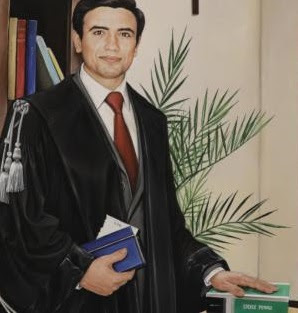
BL. ROSARIO ANGELO LIVATINO was the son of Vincenzo Livatino and Rosalia Corbo was born in Scicily in 1952.  Rosario was an excellent student all his life, always getting top marks, and graduating with honors from the law school of the University of Palermo in 1975. After working in several legal civil service positions, in 1979 he became Deputy Public Prosecutor in Agrigento, concentrating on fighting organized crime. In 1959  he was elevated to the bench, serving as a judge in the court of Agrigento. While a personally pious man, Rosario never wanted to join any clubs or associations, Church or secular, and never married

Bl. Rosario worked as a prosecutor in Sicily dealing with the criminal activity of the mafia throughout the 1980s. He confronted what Italians later called the “Tangentopoli,” the corrupt system of mafia bribes and kickbacks given for public works contracts.

 At the age of 37, he served as a judge at the Court of Agrigento.

He was driving unescorted toward the Agrigento courthouse when another car hit his vehicle, sending him off the road. He ran from the crashed vehicle into a field, but was shot in the back and then killed with more gunshots by young men paid by two Sicilian organized crime groups, the Stidda and Cosa Nostra.

Today a plaque on the highway marks the spot where Rosario was killed. It reads: “Martyr of justice.” On Dec. 21, 2020 Pope Francis elevated this title when he recognized the judge as a martyr killed “in hatred of the faith.”

His legal legacy lives on through the work of the Rosario Livatino Study Center, which is dedicated to issues of life, the family, and religious freedom.

At his beatification in May 2021, Pope Francis said: “To Rosario Angelo Livatino,  through his beatification, we give thanks for the example he leaves us, for having fought every day the good fight of faith with humility, meekness and mercy. Livatino did everything “always and only in the name of Christ, without ever abandoning faith and justice, even in the imminent risk of death. This is the seed that was planted, this is the fruit that will come.”

“He always placed his work ‘under the protection of God;’ for this he became a witness of the Gospel until his heroic death. May his example be for everyone, especially magistrates, an incentive to be loyal defenders of the law and liberty.”

 A relic of the Blessed, a shirt stained with his dried blood from the day of his murder, was venerated at the Mass in a transparent reliquary.

 His feast day will be Oct. 29. He is the patron of lawyers.

Wednesday, September 22, 2021

ALL IN THE FAMILY


VENERABLE ENRICA BELTRAME QUATTROCCHI, was the fourth and last daughter of Bl. Luigi and Maria Quattrocchi, (See BLOG 2/4/2014 )  was declared her “Venerable,” on August 30, 2021.


Her parents lived  a life full of love  and service to the Gospel and a with great human intensity.   Many of their children went on to pursue religious vocations, the older sons became priests and the third daughter was a Benedictine nun but not their youngest daughter, Enrica.  She lived a faithful single life, living in the world. She gave to God her many gifts and talents and sought to love others with a generous love.

 She was born on April 6, 1914, at Rome, Italy and died there on June 16, 2012.

Enrichetta’s life – who described herself as “God’s little ladle” – was one of prayer and charity towards everyone.

 With a degree in Modern Literature from La Sapienza University, she specialized in the History of Art, which she taught in several schools of Rome.

She was tireless in her volunteer work.  From 1936 she accompanied the trips of numerous UNITALSI patients to Lourdes and Loreto. From 1938 she was part of the Saint Vincent of Paul’s Daughters of Charity, presiding over a group of ‘ladies’ in the area of Trastevere and of Montagnola.

 During the Second World War, in contact with the Benedictine Monastery of Subiaco and the entire Beltrame Quattrocchi family, she helped Jews, soldiers, and persecuted politicians.

 Last June her remains were transferred from the Verano cemetery to the Basilica of Saint Prassede, which she frequented every day.  From 1994 she dedicated herself fully to her parents’ Cause of Beatification.

 According to Vatican News, “She was involved in volunteer work with the Daughters of Charity of St Vincent de Paul, with whom she went to the most difficult areas of Rome; in Catholic Action together with her mother; and she devoted herself to teaching. From 1976 she was Superintendent of the Ministry for Cultural and Environmental Heritage.”


Monday, September 20, 2021

CHINESE BENEDICTINE DIPLOMAT/ABBOT


The Chinese diplomat (DOM) LU ZHENGXIANG  was perhaps the most influential Chinese Christian to have lived during the Republican Era (1911-1949). He was appointed the premier and prime minister of foreign affairs, and was  the diplomat who led the Chinese delegation at the Paris Peace Conference in 1919, where his resistance to foreign bullying made him an instant hero among the people of China.

Lu was born in 1871 in ShanghaiJiangsu, and was raised a Protestant in religion and a Confucianist in philosophy. His father, Lou Yong Fong, was a  lay catechist for a Protestant mission in Shanghai. He studied at home until the age of thirteen, when he entered the School of Foreign Language in Shanghai, specializing in French.

 He continued his education at the school for interpreters attached to the Foreign Ministry, and in 1893 he was posted to St Petersburg as interpreter to the Chinese embassy. At that time the diplomatic international language was French, but Lu also gained fluency in Russian. The ambassador, the reform-minded Xu Jingcheng, took an interest in his career.

Lu married a Belgian citizen, Berthe Bovy, in St Petersburg  in 1899. Berthe’s  example of  her Catholic faith inspired Lu’s conversion in 1912. The same priest who had witnessed their marriage  received him into the Church.  In his personal memoir, he wrote about his conversion: “The last division between her and me had disappeared.” He received first Holy Communion and was confirmed by the Catholic archbishop of St. Petersburg.

After his wife’s early death, Lu Zhengxiang retired from political service and became a postulant at the Benedictine abbey of Saint-Andre in Bruges, Belgium. He was ordained a priest in 1935, and in 1946 Pope Pius XII (1876-1958) appointed him the titular abbot of the Abbey of St. Peter in Ghent.

 China’s Catholics know him best for his writings as a Benedictine monk, especially for his stirring autobiography, Souvenirs et Pensées, first published in 1945 while China was straining under the burden of a ruthless Japanese occupation and a civil war between nationalists and communists. This intimate memoir outlines his long political career and his vocation to the religious life and priesthood.


 What makes his writing particularly appealing to Chinese Christians is his insistence that Christianity is a fulfillment of Confucianism and, furthermore, that Benedictine monasticism could be the fulfillment of Buddhist monasticism in China. After acknowledging the successful implantation of Buddhism in China through monasticism, he suggests that it could be Catholic monks who finally infuse into China the truths of the Catholic faith. In his final years he hoped to return to China as a missionary. His planned departure was postponed during the Chinese Civil War, and Dom Lu died in BrugesBelgium on 15 January 1949.

 In his memoir, Dom Lu recalls some advice given to him by another Chinese statesman: “Europe’s strength is found not in her armaments, nor in her knowledge — it is found in her religion. . . . Observe the Christian faith. When you have grasped its heart and its strength, take them and give them to China.” 

Lu’s loudest exclamation to the people of China has been that despite the hackneyed refrain that “Christianity and Chinese culture do not mix well,” exactly the opposite is true. For Abbot Lu, Christianity is the most effective way to complete the insights of Chinese philosophy and bring harmony to his native China.


.:


Friday, September 17, 2021

MONASTERY RESIDENT OWL


We are lucky to have the habitat to encourage and support several species of owls, but it is not often that we see them.  For years my 4-H group and I would search tree cavities and look for the scat, to no avail.  In  2019 a Great horned owl photo was taken by our Dutch intern Marijke, though I never saw it.  (See blog  12/16/2021)

 But recently a BARRED OWL has taken up residence and seems to like humans, as it stays in plain sight. 

First it was at the home of our intern Gigi, some three miles away.  Here is a photo taken by her husband Jim as it looked into their kitchen window. After some weeks it disappeared, only to show up on monastery land.  It is still around some months later, so we must have plenty of food for it.

The barred owl (Strix varia), also known as the northern barred owl, striped owl or, more informally, hoot owl, is a North American large species of owl.

Barred owls are largely native to eastern North America, but have expanded their range to the west coast of North America where they are considered invasive. Mature forests are their preferred habitat, but they can also acclimate to various gradients of open woodlands.

Their diet is quite varied: mostly small mammals like mice, rats, chipmunks, moles, bats, rabbits, and opossums, as well as birds, fish, reptiles, amphibians, and invertebrates (like snails, beetles, and scorpions).

Barred owls are brown to gray overall, with dark striping on the underside. Barred owls have typical nesting habits for a true owl, tending to raise a relatively small brood often in a tree hallow or snag (but sometimes also in other nesting sites) in forested areas.


As a result of the barred owl's westward expansion, the species has begun to encroach on the range of the related and threatened spotted owl (Strix occidentalis). Evidence shows the assorted threats posed by the invading barred species are only increasing. In response, biologists have recommended culling operations to mitigate the negative effect of the barred on the spotted owl species.

This is a very vocal owl; best known for its nine-syllable hoot described as, “Who cooks for you? Who cooks for you all?” or “You cook today, I cook tomorrow”; also commonly barks seven notes rising in volume and ending with an loud, explosive hoot; frequently shrieks, cries, trills, grumbles, squeaks.  Mother Therese often hears it at 6 A.M.  as she prepares the chapel for Lauds.

Though it is considered nocturnal, it is also seen awake in the day as shown in photo at right- where it was often found on the monastery's cattle loading pen. 

Wednesday, September 15, 2021

MOTHER OF SORROWS


On this feast of OUR LADY OF SORROWS, at Slovakia’s national Catholic shrine,  Pope Francis said that Our Lady of Sorrows is a model of how to live the faith with compassion and care for the suffering.

“Mary, Mother of Sorrows, remains at the foot of the Cross. She simply stands there. She does not run away, or try to save herself, or find ways to alleviate her grief.


Here is the proof of true compassion: to remain standing beneath the Cross. To stand there weeping, yet with the faith that knows that, in her Son, God transfigures pain and suffering and triumphs over death.

In contemplating the Sorrowful Mother, may we too open our hearts to a faith that becomes compassion, a faith that identifies with those who are hurting, suffering and forced to bear heavy crosses.”

“Mother of the Church, Consoler of the Afflicted, with confidence we turn to you, in the joys and struggles of our ministry.  Look upon us with tenderness and open your arms to embrace us.

Queen of the Apostles, Refuge of Sinners, you know our human limitations, our spiritual failings, our sorrow in the face of loneliness and abandonment: with your gentle touch heal our wounds.”


Image:  Retable on tin, 1873  Mexico

Tuesday, September 14, 2021

BY HIS HOLY CROSS

                                                               Abraham Rattner (USA- d. 1978)


HISPANIC HERITAGE MONTH


Every year from September 15 to October 15, Americans celebrate National Hispanic Heritage Month by appreciating the community’s history, heritage, and contributions of the ancestors of American citizens who came from Mexico, Spain, the Caribbean, and South- and Central America

 Hispanic Heritage Month originally started with one week of commemoration when it was first introduced by Congressman George E. Brown in June 1968. With the civil rights movement, the need to recognize the contributions of the Latin community gained traction in the 1960s. Awareness of the multicultural groups living in the United States was also gradually growing. 

Two heavily Latinx and Hispanic populated areas, the San Gabriel Valley and East Los Angeles  (where our Mother Dilecta grew up), were represented by Brown. His aim was to recognize the integral roles of these communities in American history. 

Observation of Hispanic Heritage Week started in 1968 under President Lyndon B. Johnson and was later extended to a 30-day celebration by President Ronald Reagan, starting on September 15 and ending on October 15. It was enacted into law via approval of Public Law 100-402 on August 17, 1988. 

 September 15 is set as the starting date for the month as it is important for many reasons. It is the independence anniversary for Latin American countries El Salvador, Guatemala, Costa Rica, Nicaragua, and Honduras. From here onwards, the independence days of Mexico and Chile fall on September 16 and September 18, respectively. Dia de la Raza or Columbus Day also falls within this month, on October 12.

Hispanic Americans have been integral to the prosperity of the U.S. Their contributions to the nation are immeasurable, and they embody the best of American values. The Hispanic-American community has left an indelible mark on the U.S. culture and economy.

What will we do this month to celebrate?  Since we have a Mexican dish in one form or another weekly, I will try another Hispanic culture, maybe Peruvian?