Saturday, November 13, 2021

THOU SHALL NOT KILL


Letter in the San Juan Journal  November 10, 2021 by our good Shaw friend Gabriel Jacobs

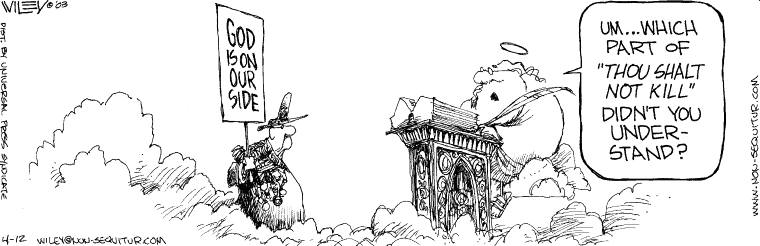
There are laws aimed at preventing people from injuring or killing others either by harming their bodies directly with fists or knives or poisons or indirectly by gun. An unmasked and unvaccinated carrier of COVID can have the same effect just as much as those who are armed. Non-vaccinated and non-masked people spread COVID far more than the vaccinated and the masked. Appalling is that the controversy lies along political lines when it is a safety, moral, and legal question. By refusing to mask and vaccinate one is ignoring thou shalt not kill.

THE BICYCLE MARTYR


The most recent priest to be beatified (September 26, 2021) , as a martyr from WWII is GIOVANNI  FORNASINI.

Bl. Don Giovanni  was born near Bologna in 1915. He is reported to have been a poor student and, after leaving school, to have worked for a time as a lift boy at Bologna’s Grand Hotel.

 He eventually entered the seminary and was ordained a priest in 1942, at the age of 27. In his homily at his first Mass,  he said: “The Lord has chosen me, rascal among the rascals.”

 Despite beginning his priestly ministry amid the challenges of the Second World War, the blessed gained a reputation as a go-getter. He opened a school for boys at his parish outside Bologna, in the town of Sperticano, and a fellow seminary classmate, Fr. Lino Cattoi, described the young priest as seeming “always to be running.”

 “He was always around trying to free people from their difficulties and to solve their problems. He had no fear. He was a man of great faith and was never shaken.” He travelled on his bicycle to be of help and bring relief to those who were in danger.

When Nazi troops carried out a mass killing of at least 770 Italian civilians in the village of Marzabotto between Sept. 29 and Oct. 5, 1944, he sought to bury the dead.

 After receiving permission from an SS captain, the young priest left on Oct. 13 to bless and bury victims of the Marzabotto massacre, but never returned.

His body was recovered at the site as the war neared its end in April 1945 and an examination revealed that Fr. Giovanni had been brutally beaten before he was killed.

 At his beatification, the Holy Father said:  “A parish priest zealous in charity, he did not abandon his flock during the tragic period of the Second World War, but rather he defended it to the point of bloodshed. May his heroic witness help us to face life’s trials with fortitude.”

 On 19 May 1950, the President of Italy,Luigi Einaudi  conferred upon Don Fornasini posthumously Italy's Gold Medal of Military Valour. The award was presented to his mother, Maria, on 2 June 1951. The citation reads:

In his parish of Sperticano, where all true men fought in the mountains for the freedom of their Fatherland, he was a shining example of Christian charity. Pastor to the old, to the mother, to the bride, to the innocent child, he several times shielded them with his own body against the heinous atrocities of the German SS, saving many lives from death and encouraging all, both the fighters and their families, to heroic resistance. Arrested, miraculously escaping death, he at once and boldly resumed his role as pastor and soldier, first among the ruins and massacres of his destroyed Sperticano, then at San Martino di Caprara; where, however, he was struck down by the ferocity of the enemy. The voice of Faith and of Fatherland, he had dared fiercely to condemn the inhuman German massacres of so many of the weak and of the innocent, thereby calling down upon himself the barbarity of the invader and being slain; he, the Shepherd who had always with the utmost courage protected and guided his flock by his piety and by his example. – San Martino di Caprara, 13 October 1944

 Blessed Giovanni's feast day is October 13

Wednesday, November 10, 2021

UPDATE ON A FAVORITE SAINT


Pope Francis will canonize BLESSED CHARLES de FOUCAULD,  (See Blog  March  2013) considered to be one of the pioneers of interreligious dialogue, together with six other Blesseds, during a Canonization Mass in St. Peter’s Basilica on 15 May.

The announcement was made on Tuesday by the Congregation for the Causes of Saints. It follows the Ordinary Public Consistory of 3 May 2021, whereby the Pope had authorized the canonizations, without however setting a date for the ceremony due to the health emergency caused by the Covid-19 pandemic.

Blessed Charles de Foucauld, born in 1858, was a French aristocrat and religious, whose work and writings led to the founding of the Congregation of the Little Brothers of Jesus. During his adventurous life, he was a Cavalry Officer in the French Army, and then an explorer and geographer before becoming a Catholic priest and hermit who lived among the Tuareg in Algeria’s Sahara Desert

He lived a life of prayer, meditation and adoration, in the incessant desire to be, for each person, a "universal brother", a living image of the love of Jesus. On the evening of December 1, 1916, he was killed by bandits.

At his beatification in 2005, Pope Benedict XVI said that as a priest, Foucauld “put the Eucharist and the Gospel at the center of his life.”

“He discovered that Jesus — who came to unite Himself to us in our humanity — invites us to that universal brotherhood which he later experienced in the Sahara, and to that love of which Christ set us the example,” Pope Benedict said.

Tuesday, November 9, 2021

THE ITALIAN FR. KOLBE


FRIAR PLACIDO CORTESE who helped to rescue Jews during the Holocaust was named Venerable in August (2021).

Like St. Maximilian Kolbe, Venerable Cortese was a Franciscan friar who directed a Catholic publication and was tortured and killed by the Nazis.

 He is remembered for using his confessional in the Basilica of St. Anthony in Padua to clandestinely communicate with an underground network that helped Jewish people and British prisoners of war escape the Nazi occupation of Italy.  He is  known locally as “the Italian Fr. Kolbe”.

 He was born in 1907 on the island of Cres, which is now part of Croatia. At the age of 13, he entered the minor seminary with the Order of Friars Minor Conventual and took the name Placido after taking his vows in 1924.

 He studied theology at the St. Bonaventure Theological College in Rome and was ordained a priest in 1930 at the age of 23. He offered his first Mass in the Basilica of St. Mary Major.

 He spent several years serving at the Basilica of St. Anthony in Padua, where he was asked to be the director of the Italian Catholic magazine Il Messaggero di Sant’Antonio (The Messenger of Saint Anthony), whose readership grew by 500,000 under his leadership.

 After the German occupation of Padua, Friar Cortese was part of an underground group linked to the Resistance, using his printing press to make false documents to help Jewish people and Allied soldiers reach safety in Switzerland.

 In October 1944, two German SS officers tricked the venerable into leaving the walls of his monastery in Padua, which was protected as an extraterritorial territory of the Holy See, on the false pretext of someone needing his help


He was immediately arrested and taken to a Gestapo bunker in
Trieste, where he was brutally tortured, but he did not give away the names of any of his associates.

 After weeks of torture, he died in Gestapo custody in November 1944 at the age of 37. His confessional in the Basilica of St. Anthony of Padua continues to be a place of prayer today.

In one of his letters to his family, Venerable  Placido wrote: “Religion is a burden that one never tires of carrying, but which more and more enamors the soul toward greater sacrifices, even to the point of giving one’s life for the defense of the faith and the Christian religion, even to the point of dying amid torments like the martyrs of Christianity in distant and foreign lands.”

In all the photos I could find of this new Venerable, he seems so joyous

Thursday, November 4, 2021

ALL SOULS DUE TO COVID


All Souls Day- Ivan Milev- Bulgaria


November is not only the month of saints, but also  ALL SOULS.  The latest statistics re. the Covid 19 is astounding- the kind of figure which is hard to get your head around.

 The number who have died of COVID-19 has surpassed 5 million world wide.  The United States alone includes 745,800 deaths.

That grim statistic exceeds the number of deaths in the United States due to the 1918 influenza pandemic, which the Centers for Disease Control estimates was about 675,000.

An overwhelming majority of Americans who have died in recent months, a period in which the country has offered broad access to shots, were unvaccinated. Because of the Delta variant, the United States has had one of the highest recent death rates of any country with an ample supply of vaccines. The South was especially hit hard due to people refusing vaccinations. 

We continue to pray for the safety of all as well as the souls of all who have died.  RIP

FRIENDS IN THE VATICAN


The Franciscans,  who we have been close to for 50 years in Connecticut, as well as here on Shaw, now represent us in the Vatican.

Pope Francis has appointed Sister Raffaella Petrini, a member of the Franciscan Sisters of the Eucharist, as Secretary-General of the Governorate of Vatican City State. Since 2005 she has served as an official at the Congregation for the Evangelization of Peoples. 

Born in Rome on 15 January 1969, she holds a degree in political science from the Libera Università Internazionale degli Studi Sociali Guido Carli (LUISS) and a doctorate from the Pontifical University of St. Thomas Aquinas (the Angelicum), where she is currently a professor. 

Sr. Raffaella is the first woman and non-clergy member to be secretary general of the Vatican’s governorate.

The appointment makes her one of the highest-ranking women at the Vatican, alongside Sr. Alessandra Smerilli, “ad interim” secretary of the Dicastery for Promoting Integral Human Development, and Sr. Natalie Becquart, an under-secretary of the Synod of Bishops.


Sister Rafaella replaces Bishop Fernando Vérgez Alzaga, who was promoted to president, effective Oct. 1.


 Sister Raffaella is also a professor of the economy of welfare and sociology at Rome’s Pontifical University of St. Thomas Aquinas (the Angelicum), where she received a doctorate in social sciences.

She also has a master’s degree in organization behavior from the University of Hartford in Connecticut.

Tuesday, November 2, 2021

THE NAZIS FIRST PRIEST MARTYR


In his Angelus, November 1, the Holy Father said regarding the saints: The Beatitudes show us the path that leads to the Kingdom of God and to happiness: the path of humility, compassion, meekness, justice and peace…The joy of the Christian is not a fleeting emotion or a simple human optimism, but the certainty of being able to face every situation under God’s loving gaze, with the courage and strength that come from him.”

 The following martyrs knew this courage, that can only come from Christ.

The first of more than 2,600 Catholic priests killed under the Nazis was FATHER OTTO NEURURER,  who was beatified at St. Peter’s Basilica on November 24, 1996, by Pope St. John Paul II. 

Otto Neururer was born in Tyrol, Austria, in 1881. He was the 12th and youngest child of a peasant farmer, Alois Neururer, and his wife, Hildegard. When Otto was 8, his dad died. His mom, a devout Catholic, began suffering bouts of depression. Otto was a bit frail and also timid and, like his mom, also began experiencing bouts of depression. Nevertheless he had a brilliant mind and recognized his vocation to the priesthood. He followed his calling and was able to enter the seminary when he was 21 years old.

 He was ordained to the priesthood in 1907 and celebrated his first Mass in his hometown. He wanted to join the Jesuits and do missionary work, but his frail health prevented that. He served as a parish priest and teacher, and was finally assigned as pastor to St. Peter and Paul Parish in Innsbruck

 In 1938, while he was still pastor, a young woman came to him for advice. She wanted his opinion on whether or not she should marry a divorced man. Father Neururer knew of this man, that he was a philanderer and a con artist. He advised the woman against marrying him. She told her “fiancé” that she could not marry him and why. This man, though, was good friends with the Nazi party leader in the area and reported Father Otto to him. On December 15, 1938, Father Otto was arrested and charged with “slander to the detriment of German marriage.” 

On March 3, 1939, Father Otto was sent to Dachau, the first concentration camp established by the Nazis, to a section known as the “priests’ barracks.” Here he was routinely tortured, but this would not be his last stop. On September 26, 1939, he was sent to Buchenwald, which was under the command of Martin Sommer, aka “the Hangman of Buchenwald.” This would be Father’s last stop.

A prisoner came to Father Otto and asked for baptism. The priest could not decline and performed the sacrament as requested. Father Otto suspected that it might be a set-up, but he couldn’t refuse administering baptism, in case it wasn’t. It was a set-up, and Sommer decided to make an example of the priest. He ordered him taken to the “punishment block” and hanged upside down. 

The chaplain who witnessed Father Otto’s torturous death reported that he never complained. The priest lived for 34 hours, and even toward the end, he could be heard mumbling his prayers. He died on May 30, 1940 at the age of 58.