Saturday, October 1, 2022

MARTYR FOR THE ROSARY


I had planned to devote the month of October to some modern day martyrs from the Ukraine and Poland and start with a story I just read.

This week we celebrate the feast of our Lady of the Rosary. And in the news, very relevant to the on-going crises in the Ukraine, is a story of a Ukrainian woman who died praying the rosary.

JANINA JANDULSKA was a 30-year-old disabled woman, who led a Rosary prayer group. In 1937 she was arrested and accused of leading an underground political organiZation opposed to the Soviet government. She was murdered while still in police custody.

In 1937, Janina was living in Ukraine, in the village of Wierzboviec with her mother. Like other people in the village, she joined a prayer group, called “Living Rosary.” These sort of groups became popular after the establishment of the Soviet Union.

 Her country became part of the USSR after the Bolshevik revolution, in 1917.

At that time, the dictator Joseph Stalin wanted to reunite the old Russian Empire. Once their power was assured and growing, they began to persecute Christians.


After the government closed the seminaries and arrested priests, the faithful were left to find other ways of meeting. Prayer services were led by lay people who also taught the catechism to young people.  

Janina began hosting the meetings of the “Living Rosary” prayer group in her own home.  A communist official was informed about the meetings and alerted the authorities. The police arrived at the girl’s house and arrested her.

 Later, she had the following conversation with the state prosecutor:

“Are you the organiser of the Rosary?”

-“Yes, I am the leader of the Living Rosary. But it is not an organisation. We are just praying to God.”

– “How many people are there?”

– “Fifteen.”

– “Fifteen! And you say it is not an organisation. Who recruited you and who sent you the books?”

The prosecutor would not accept Janina’s explanation when this simple disabled girl said that they just gathered to pray. His cross examination continued:

-“But God does not exist.”

-“For you, God does not exist. But for us, he exists.”

 He looked at the poor woman in front of him and continued:

-“Now you are here, so who will replace you?”

-“Someone who believes in God,” answered Janina.

Sometime later, Janina’s mother was informed about her daughter’s death. The cause of her death was falsely stated to be caused by a “liver infection”, but  later, it was revealed that she died from a bullet fired into her head.

Today, Janina’s picture hangs in a Catholic church in her hometown, where she is honored as a martyr of the faith. May she intercede for the people of her country, and may we all pray to our Mother of the Rosary for an end to the plight of the Ukrainian people.

Painting: Natale Bentivaglio Scarpa (d. 1946) Italian

Monday, September 26, 2022

THE WORK OF SISTER PAULINE

Another nun who recently came to my attention was one I knew many years ago. I found that she died two years ago. We knew each other through the Delta Society, an organization dedicated to study of the human/animal bond.  We traveled the world together doing conferences and workshops.

 When I knew her she was not yet a professed religious, yet had the garb of one, and frankly in those early days I did not know what to make of her, but respected her dedication to her work and desire to better the lives of others.

SISTER PAULINE QUINN is credited with starting the first prison inmate dog-training program (DTP) in the state of Washington in 1981. (Since then, 36 states across the country have adopted various types of prison-based or jail-based animal programs. The most common type of program involves inmates providing care and training for animals from local shelters or rescue groups and, upon completion of training, the dogs are then put up for adoption.

In partnership with the late Dr. Leo Bustad, former chair of Washington State University’s veterinary program, Sister Pauline started the program, called Prison Pet Partnership, at the Washington Corrections Center for Women (WCCW) in Gig Harbor.

Sister Pauline was born Kathleen on December 10, 1942, in Hollywood, California.  Our birthdays were two days apart and we were born  in the same city.  She ran away from home at a young age due to family problems and sexual assaults. 

Trying to escape one set of abuse, she ran into more on the streets, causing her more physical and mental trauma.  

Later, Kathleen got the help of a nun, and a policeman pitting her, gave her a retired police dog, Joni, a German Shepherd.  Joni’s unconditional love, companionship and protection gave her a sense of security, the connection of love, and the dignity of a person for the first time in her life.

She would often say, dog was God spelled backward. To her, “dog” was like a mirror reflection of “God” who also gives  people unconditional love and acceptance.

It was because of this healing experience from her dog, that she started her work. But it was not only involving animals.  In 1985, she founded Pathways to Hope and later Bridges and Pathways of Courage, which encompassed the many projects with which she was involved.

Sister Pauline’s other ministries included volunteering with the Comboni Refugee Center in Rome, where she arranged medical care and transportation for the victims of the Bosnian and Gulf wars, as well as assisting refugees from Angola, Ethiopia, and Somalia. She traveled to Haiti after the 2010 earthquake and undertook many other global missions of mercy. 

She was a real humanitarian and had an amazing  gift of “conning” people  to bring aid to those in dire need. She made a huge difference in many people’s lives.

Perhaps because a nun had helped her early in her life, she longed for religious life, but many orders found her “strange”  or too old.  In those early days I knew her, I had a sense that she felt  “safe” in religious garb, which also opened doors for her work.

The  Dominicans accepted her  and  in 1996 Sister Pauline made her final profession of vows to Bishop Raúl Vera López, OP.  “Did you know the word Dominican comes from the Latin words ‘domini’ for God and ‘cani’ for dogs. Dominicans are dogs for God.”  Sr. Pauline said she worked like a dog for God.

Sister Pauline became a resident of the Dominican Life Center in 2018  and died on Friday, March 13, 2020, at the Dominican Life Center in Adrian, Michigan. She was 77 years of age.

 In 2016 Secrets Shared: The Life and Work of Sister Pauline Quinn, OP  written by Susan Nagelsen and Charles Huckelbury was published.

“It is a story of my life traveling on a journey because it was something that God was speaking to my heart to do.  No matter what happened, I wouldn’t give up. Even though I fell many times from the pressure of rejections and indifference, I kept standing up brushing the dirt off then went out and helped thousands…

God works in mysterious ways to show us his compassion and mercy for others, hoping that we learn that all life is important and we have the strength to help rebuild damaged lives by our love. I had no high school education, wounded, little support yet I went out and helped thousands because I found within the Dominican family where I belong”.  

May she now rest in the peace of the Lord.


Wednesday, September 21, 2022

HER LIFE FOR PRIESTS


I recently received a book about a little known Benedictine contemplative nun who, while born of Polish parentage, was born in the Ukrainian city of Lviv (then part of Poland).

SISTER BERNADETTE of the CROSS (nee Rozmarynka Wolska) was a Benedictine Nun of Perpetual Adoration born in 1927 of a family of land owners.

Her life was recently brought to light in the book For Their Sake I Consecrate Myself.           

 Sister Bernadette’s mother, when pregnant with her, was tempted to abort her daughter upon receiving medical advice from her gynecologist that her health was too poor to carry the baby to term. A relative persuaded her to keep the baby at the risk of her life. Both mother and child survived, and her mother gave birth to three more children. 

 Rozmarynka (Rosemary) was fun-loving, and had a “strong will and inexhaustible energy.” She was known to have a temper, which she fought her whole life.  She loved reading novels and poetry, singing and art, knitting and sewing, and sports- skiing, hiking, horseback riding, and sailing- in fact anything outdoors.  

While living in Kraków, she became a lay oblate at the Abbey of Tyniec and  under their influence her  spiritual life blossomed as she discovered God in nature, friendship, Scripture, and the liturgy. The first thought of life as a religious, occurred to Roza after a sermon preached in Krakow by  Father Karol Wojtyła—the future Pope St. John Paul II.  An Oblate of this same Abbey was Bl. Hanna Chrzanowska (see Blog  April 6, 2018).

In 1951, after graduating from the Academy of Fine Artsshe joined the Monastery of the Benedictine Nuns of Perpetual Adoration of the Blessed Sacrament. (Order founded in Paris, France in 1653 by Bl. Mechtilde of the Blessed Sacrament- (see Blogs Oct. 9, 2021 & April 7, 2017).

Those were the most difficult years under the Communist regime for Poland; the monastery was being rebuilt after having been bombed in the war and yet it's spiritual life flourished. 

In religious life she was known for her common sense, childlike simplicity, maturity, and love of Christ. She was also know for her humility as well. “Remembering that which IS—that is why God graciously tears down our plans, built on nothingness, so that we may anchor ourselves in Him”.

In her breviary, she kept a bookmark with a quotation from Mother Mectilde - “To be a victim is to accept every tribulation.” Sister Bernadette desired to offer herself as a “holocaust” to God specifically, to offer her life in reparation for the infidelities of the priesthood, of priests abandoning their vocation in Communist Poland. 

 In 1963, it was discovered she had lesions on her reproductive organs, which caused her great pain. She was sent to a Communist hospital for a routine surgery. Before her surgery, she begged the Lord: “Cut me in strips, but let them return to You and give You glory.”  After her surgery, complications arose. She was in terrible pain caused by a “twisted bowel and intestinal adhesions.” Due to neglect on the part of the Communist doctors, little could be done to fix the botched surgery.

Sister Bernadette found joy in her suffering. On her deathbed, she confided to her superior, Mother Celestyna: “But that is not at all why I want to die; suffering is also a great happiness. I want to suffer as much as possible for a few more moments, there is no more suffering there…I feel a great power inside me. It is not from me, but from Him.”  She died on April 30, 1963, at the age of 35. 

The book was written by Sister Jadwiga Stabińska, born in Grodno (then in Poland, today in Belarus) in 1935. After studying psychology at the University of Warsaw, she entered the Benedictine Nuns of Perpetual Adoration of the Blessed Sacrament in Warsaw. She made her solemn vows in1960 and began her work as a writer. Many of her articles, poems and translations were published in various Catholic magazines. Her most important work was the book “Faces of Contemplation” (1977) for which the Holy Father John Paul II himself thanked her. She died in 2016, after a long battle with cancer at 81 years of age, 59 of which were spent in monastic profession. 


Friday, September 16, 2022

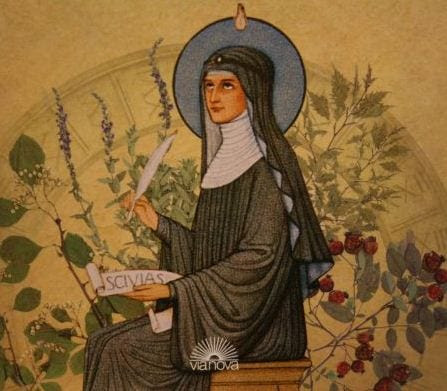
VIRIDITAS - FIRST WOMAN ECOLOGIST?


God speaks:

“I am the breeze that nurtures all things green
I am the rain coming from the dew
that causes the grasses to laugh with joy of life.
I am the yearning for good.”

SAINT HILDEGARD is considered to be the founder of scientific natural history in Germany. “God desires that all the world be pure in his sight. The earth should not be injured. The earth should not be destroyed… As often as the elements, the elements of the world are violated, by ill-treatment, so God will cleanse them. God will cleanse them thru the sufferings, thru the  hardships of humankind”, she wrote 10 centuries ago.

She saw the earth as a living organism endowed with the same vital power that animates all life forms. It was a central theme in her life and work. Where she gained her knowledge of the natural world is open to debate but certainly some of it came from not only her awareness of the unity of all things from her mystical inspiration, but also from the pagan heritage of the time, then still very much alive in the Germanic world, particularly in the knowledge “de occultis operationibus naturae” (the hidden workings of nature), which would later be the object of witch hunts.

St. Hildegard’s Physica, the first German herbal treatise, and Materia Medica, in which she catalogs the properties of plants, trees, birds, fish, and stones, attest to her knowledge, competence, and concern for the physical world. Her Causae et Curae (originally called the Book of the Subtleties of the Diverse Nature of Creatures) echoes this conscious awareness wherein she discusses the physical processes for the human body and its interrelatedness to the natural world.

Her holistic healing abilities, which are studied to this day, show that she likely practiced a Middle Age version of biodynamic farming, an approach to agriculture in which the intrinsic properties of plants is known to create a balanced regenerative ecosystem, when practiced.  

For St. Hildegard, the earth was sacred. She helped the people of her day to better understand themselves
and the planet. She saw a spiritual kinship between humankind and the earth: “The soul is a breath of the living spirit, and with excellent sensitivity, permeates the entire body to give it life. Just so, the breath of the air makes the earth fruitful. Thus the air is the soul of the earth, moistening it, greening it”.

Her idea of viriditas was foundational to her understanding the Holy Spirit, the vivifying breath that animates all living things. She saw that armed with our own viriditas, we can embark on the phenomenon of being “carried ever so lightly like a feather on the breath” of some greater life force.

 She felt  the whole earth was the place where God’s Spirit and our spirit meet to produce a holistic wellness for each individual  person as well as  a profound mutual relationship with the natural world.

One of St. Hildegard’s most enduring symbols was the  tree, which she used as a metaphor for the growth of the soul. “The soul is in the body, just like the sap is in the tree. Understanding grows in the soul, just like the greening of branches and the leaves of the tree. Therefore O person, you who think your understanding is good, understand what you are in your soul.” 

 There is a new book on the works of St. Hildegard, which I  recently received.  To quote the cover:

GREEN MASS is a meditation on—and with—twelfth-century Christian mystic and polymath Saint Hildegard of Bingen. Attending to St. Hildegard's vegetal vision, which greens theological tradition and imbues plant life with spirit, philosopher Michael Marder uncovers a verdant mode of thinking. The book stages a fresh encounter between present-day and premodern concerns, ecology and theology, philosophy and mysticism, the material and the spiritual, in word and sound.

 Introduced with a foreword by philosopher Marcia Sá Cavalcante Schuback and accompanied by cellist Peter Schuback's musical movements, which echo both St. Hildegard's own compositions and key themes in each chapter of the book, this multifaceted work creates a resonance chamber, in which to discover the living world anew.

The original compositions accompanying each chapter are available free for streaming and for download at www.sup.org/greenmass

The author, Michael Marder is Ikerbasque Research Professor of Philosophy at the University of the Basque Country (UPV/EHU), Vitoria-Gasteiz. His work spans the fields of environmental philosophy and ecological thought, political theory, and phenomenology, with books including Dust (2016), Heidegger: Phenomenology, Ecology, Politics (2018), and Pyropolitics in the World Ablaze (2020).

For followers of this great saint, I highly recommend the book. It proves that since St. Benedict, we Benedictines have been concerned with the care of our natural world.


Tree Frog photo:  Amie Garabaldi

Tuesday, September 13, 2022

HOLY CROSS PRAYER FOR UKRAINIANS


Tomorrow is the feast of the Holy Cross and Catholic bishops have requested “Eucharistic Adoration at every church in Europe” in order to pray for peace inUkraine. The effort has been started by the Council of European Bishops’ Conferences (CCEE), which calls on European Catholics to assemble on September 14 “on their knees in front of the Blessed Sacrament to pray that the Lord may bring peace to Ukraine.”

 The Ukrainian Catholic bishops who designated 2022 to be the Year of the Holy Cross for Ukrainian Catholics served as an inspiration for the prayer campaign.

 In a statement to celebrate the start of the Year of the Holy Cross, the Ukrainian bishops stated: “Since Russia invaded Ukraine, we are travelling a terrible path of the cross, on which innocent people suffer, are injured, and dead. There is a lot of evil, a lot of sorrow.”

 “At this moment, we are more vividly aware than ever of what the crucifixion of the innocent is and what violence against the innocent means. We comprehend Jesus Christ’s journey to the cross, His agony, and His death as an innocent Lamb who was killed by individuals who committed their lives to the service of evil, now more than ever”.

On the feast day of September 14, a liturgy and the Stations of the Cross will be held at the Shrine of the Lord’s Passion in SharhorodUkraine, to mark the end of the Year of the Holy Cross in that country

In union we pray this prayer: 

Almighty and Great God,

accept our gratitude for your boundless mercy towards us.

Hear the supplication of our afflicted hearts for the land and people of Ukraine,

as they confront foreign aggression and invasion.

Open the eyes of those who have been overtaken

 by a spirit of deception and violence,

that they be horrified by their works.

Grant victory over the powers of evil that have arisen

and bless Ukraine with your gifts of liberty, peace, tranquility, and good fortune.

We implore you, O Merciful God,

Look with grace upon those who courageously defend their land.

Remember the mothers and fathers, the innocent children,

widows and orphans, the disabled and helpless,

those seeking shelter and refuge,

who reach out to you and to their fellow human beings

looking for mercy and compassion.

Bless the hearts of those who have already shown great generosity and solidarity,

and those who prepare to receive their Ukrainian brothers and sisters

in Ukraine’s greatest time of need.

Bring us together as your children, your creation,

and instil in us your strength, wisdom and understanding.

May you be praised and glorified,

now and forever, and to the ages of ages. Amen.

Friday, September 9, 2022

A WOMAN OF VALOR


                                                      REST  IN  PEACE


Photo Jane Brown (2006)  

for Queen’s 80th BD


Monday, September 5, 2022

A NEW FERRY FOR A FRIEND


 As we wind down summer in the Pacific Northwest, specifically on ferry serviced islands with no bridges, we pray the ferry service will be kinder, ie. more on time  and more crews. But the news this past week is of another ferry far from us, but dear to our hearts, as it is named after a dear friend of our Abbey in CT. (She was "God-mother"  to our OLR foundress, Mother Prisca, who helped her found Rochester, NY Catholic Worker Center) 

New York has three new 4,500-passenger ferry boats, the first new boats added to the fleet since 2006, and one is named after DOROTHY DAY.  They were funded with a combination of federal, city, and other grant funds.

 The Dorothy Day will be the third Staten Island Ferry named for a woman. The first, which was decommissioned in the 1970s, was named for Revolutionary War hero Mary Murray. The second, which still operates overnight, is named for Staten Island photographer Alice Austen.  

“Dorothy Day lived a life of tremendous selflessness and service. I can think of no greater way to honor her beloved legacy than by having her name on this new ferry boat connecting Manhattan and Staten Island,” said past Mayor Bill de Blasio. “Day loved Staten Island, and this naming will allow others to learn of her inspiring work as a brave activist and journalist. I thank Day’s surviving family for doing keeping the memory of her work alive, and hope every New Yorker can draw inspiration from her legacy.’”

Servant of God Dorothy was born in Brooklyn in 1897 and spent years on the Lower East Side and Greenwich Village. She moved to Staten Island in the 1920s, where she raised her only daughter in the Spanish Camp shore section.  Following her work co-founding the Catholic Worker Movement, which included offering food and shelter to those in need on the Lower East Side during the Great Depression and creating the Catholic Worker newspaper, she returned to Staten Island to operate a cooperative farm after 1950 in Pleasant Plains on Bloomingdale Road with French philosopher Peter Maurin. Dorothy later became best known for her pacifism and work on behalf of the oppressed and public support of striking farm workers.

 She spent most summers in her later life in the Huguenot neighborhood on Staten Island. Following her death in 1980, Dorothy was buried at Resurrection Cemetery in Pleasant Plains on the Island

 “How providential that the ferry from lower Manhattan to Staten Island should be named after a brave, loving woman who cherished both those areas of our city and the people who live there,” said Timothy Cardinal Dolan, Archbishop of New York. “How appropriate that a ferry transporting people would honor a believing apostle of peace, justice, and charity who devoted her life to moving people from war to peace, from emptiness to fullness, from isolation to belonging.”

The Dorothy Day is “ready for passage” having left Eastern Shipbuilding Group’s Port St. Joe shipyard in Panama City, Fla. on Friday after being inspected and certified.

 The Dorothy Day will be towed by Sarah Dann of Ocean Towing and is scheduled to dock in New York City in approximately 14 days, weather permitting. This makes Dorothy Day due for arrivals on or about Friday 16th September.