Monday, March 18, 2013

WOMEN of the CHURCH


Original Icon by Fr. Theodore Jurievicz
Front: Anna, Elizabeth, Mary Magdelene, Nina (evangelizer of Georgia);
Back: Juliana of Lavarevsk, Irene Martyr of Thessalonica, Barbara, Alexandra the Empress.

A Prayer For The Times: Litany of Women for the Church
                                     
Sister Joan Chittister, OSB

Dear God, creator of women in Your own image,
born of a woman in the midst of a world half women,
carried by women to mission fields around the globe, made known by women to all the children of the earth,
give to the women of our time
the strength to persevere,
the courage to speak out,
the faith to believe in You beyond
all systems and institutions
so that Your face on earth may be seen in all its beauty,
so that men and women become whole,
so that the church may be converted to Your will
in everything and in all ways.
Sts. Benedicta of the Cross, Teresa of Avila, Therese of Lisieux, Catherine of Siena


We call on the holy women
who went before us,
channels of Your Word
in testaments old and new,
to intercede for us
so that we might be given the grace
to become what they have been
for the honor and glory of God.

Saint Esther, who pleaded against power
    for the liberation of the people, -Pray for us.
Saint Judith, who routed the plans of men
    and saved the community,
Saint Deborah, laywoman and judge, who led
    the people of God,
Saint Elizabeth of Judea, who recognized the value
    of another woman,
Saint Mary Magdalene, minister of Jesus,
    first evangelist of the Christ, pray for us.

St. Scholastica- De Wit
Saint Scholastica, who taught her brother Benedict
    to honor the spirit above the system,
Saint Hildegard, who suffered interdict
    for the doing of right,
Saint Joan of Arc, who put no law above the law of God,
Saint Clare of Assisi, who confronted the pope
    with the image of woman as equal,
Saint Julian of Norwich, who proclaimed for all of us
    the motherhood of God,
Saint Thérèse of Lisieux, who knew the call
    to priesthood in herself,
Saint Catherine of Siena, to whom the pope listened,

Dorothy Day- B. Tsai, 1998
Saint Teresa of Avila, who brought women's gifts
    to the reform of the church,
Saint Edith Stein, who brought fearlessness to faith,
Saint Elizabeth Seton, who broke down boundaries
    between lay women and religious
    by wedding motherhood and religious life,
Saint Dorothy Day, who led the church
    to a new sense of justice, pray for us.

* * * ******
Mary, mother of Jesus,
    who heard the call of God and answered,
Mary, mother of Jesus,
    who drew strength from the woman Elizabeth,
Mary, mother of Jesus,
    who underwent hardship bearing Christ,
Mary, mother of Jesus, who ministered at Cana,
Mary, mother of Jesus, inspired at Pentecost,
Mary, mother of Jesus, who turned the Spirit of God
    into the body and blood of Christ, pray for us. Amen.
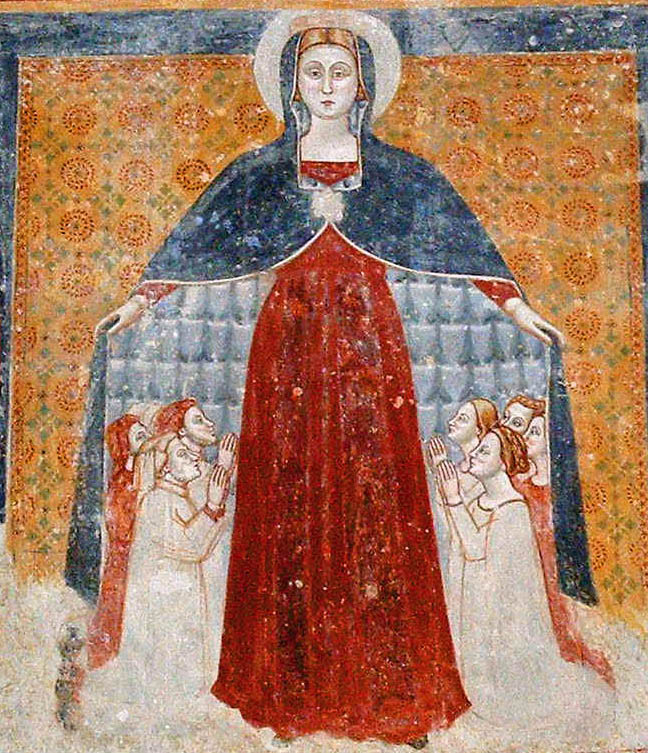

Mary Mother of the Church

Saturday, March 16, 2013

LAMBS ARE HERE- THE GENTLE GIANTS


Rachel with Antonia and her lambs

One of the world's most beautiful and rare sheep comes from the hills of the Cotswolds in England less than 20 miles from the Welsh border. They are thought to be descended from a long wool introduced by the Romans in the first century A.D.  This prototype sheep gave birth to the Cotswold, Lincoln and Leicester. The Cotswold was well established by the 15th Century and the wealth obtained from these "gentle giants" paid for many of the great Cathedrals and churches in England, most notable Gloucester Cathedral, which has the largest stained glass window in all of Britain. Today the Chancellor of the Exchequer still sits on a sack of Cotswold wool in the House of Commons, as a symbol of Britain’s secure wealth.  The word Cotswold stems from the wolds (hills) and cotes (enclosures) which housed the sheep in bad weather, hence the wolds of the sheep cotes. Cotswolds played a great part in early American farming history even though today they are rare.

They were first introduced by Christopher Dunn into New York, near Albany in 1832. By 1879 this was the most popular breed in America.  By 1914 over 760,000 were recorded and it was still a very popular breed in the West until Merinos were introduced from Australia. Merinos had the finest  fleece and quick maturing lambs. By the 1980's there were fewer than 600 Cotswolds in all of Britain and in the US in 1993 there were less than 400 lambs registered.  Thanks to the American  Livestock Breeders Conservancy and other groups they have been removed from the "rare breed list" and are enjoying popularity among spinners.

The Cotswold is a large, polled breed, with ewes weighing up to 200 pounds and rams 300 pound. The ewes are excellent mothers, with few birthing problems and quick to accept lambs. Their milk has %14 butterfat.  The meat has a very mild flavor and aroma. It has been proven that long wool sheep have a less mutton flavor than fine wool breeds. Cotswolds are easy to raise and do well on coarser feeds, are excellent foragers, and can thrive in harsh climates, even with a lot of rainfall. In 20 years of breeding this hardy, wonderful breed we have had very few vet bills.

Annie feeding new moms & lambs

They are a very friendly sheep and there is definitely a queenly quality about the ewes. The rams are known to be very gentle and much less aggressive than rams of other breeds.

The earliest Cotswolds were white but black Cotswolds were recorded in Kentucky in 1858.  They are even rarer than the whites, and it is not known if the incidence of color  is due to  recessive  genes or some fence jumper from long ago!  They should have the same characteristics as the whites.       
                                                                                                                                                                                                                                                                                                                                                                                                                                                                                                                                                                                                                                                                                                                                                                                                       There is a revived interest in Cotswolds due to the desire of sheep growers to improve wool quality and produce lean, heavyweight lambs on less feed. The Cotswold  can yield 10-12 pounds of wool per shearing with the fiber up to 12" long. It is  highly lustrous fleece with a micron  count in the 40s and is sometimes called “poorman's mohair”.In spite of the heavy grease (lanolin), the fleece washes easily with liquid detergents and hot water and dries rapidly after a spin dry in the washer.

Lunch time
It can be spun uncarded  (we weave a blanket from the unwashed natural locks), flicked, combed or drum carded.  It readily accepts dye and the natural color silver yields lovely heather colors of green, violet and blues.  It blends well with other fibers from alpaca to silk.  The wool is natural for felting as it “cots” easily. It is a favorite with sock knitters and is great for sweaters, scarves, and woven into blankets.

Over the years, while keeping a few whites, we have specialized in the natural colored sheep. We love our "gentle giants".


Cotswold curls
Annie with lamb
Newly shorwn fleece

Thursday, March 14, 2013

AMAZING MAN FROM ARGENTINA


WE REJOICE WITH THE UNIVERSAL CHURCH 
                                              IN THE ELECTION OUR POPE FRANCIS I

Wednesday, March 13, 2013

PERUVIAN SHEPHERDS

Preparing to spin
Shepherd with his sheep
While anxiously awaiting our spring lambs, and  also preparing for a trip to Peru in late May, I present these wonderful old paintings from the Trujillo area of Peru.  I am not sure of the century but they certainly represent another era. Cotton and wool (from sheep) were once major products of Peru, but today so much is imported from China and other third world countries, that it is hard to find good quality hand-made items of wool.  Even in the mountain villages the sacks carried (as we do purses) are of synthetic materials.


 Yes, there is the famous alpaca, but even then one must be warned as more often than not, synthetic material is woven into the fiber, thus reducing the cost and certainly the quality.  Experts say that if you hold the material to the light and can see "sparkle", then it is not pure alpaca.

Shearing the sheep


Shepherdess spinning
When I was in Northern Peru three years ago, we found very few flocks of sheep. We tried many times to find local weavers, but with little success.  One old woman told us that no one wants to raise the animals or do the work today. It is cheaper to just buy imported goods. We did manage to find one woman in the high village of Ayabaca (9000') who had a small flock and was famous for her spinning and weaving. Once  a month she would go down the mountain road  to sell her wares in the city.


One of my favorite stories relates to how people in the mountain areas just show up and then vanish. My friend and guide Jeremy and I were returning to the village of Ayabaca by car, from an afternoon of birding.  Ayabaca is in what is known as a Cloud Forest.

Clouds starting to cover forest

 One has to experience it to believe it.  As you walk suddenly you can't see in front of you for the clouds enveloping everything. Outside the village we stopped for a couple of locals to give them a ride, but as we were to stop at the weavers, they hopped out when we arrived at her house. As we got back in the car to return to the village,  which we could not see in front of us, I turned to Jeremy in the back seat and there sat a strange man.  I asked, "who is he?"  Jeremy replied, "I haven't a clue, he just needs a ride!"

Sheep returning home in the Clouds


Tuesday, March 12, 2013

FAITH in the MODERN WORLD


At the end of last year, Our Holy Father Pope Benedict XVI declared 2013 the YEAR of FAITH. I recently found some thoughts by Our Benedictine Abbot Primate, Notker Wolf OSB. While this message was for Advent, I feel it very appropriate during this Lenten Season, especially in light of the changes in our Church..

"New Evanglization begins with ourselves. We direct our lives completely according to God’s Word, we allow ourselves to be gripped my him, steeped in him and slowly changed so that it no longer we who live but Christ lives in us. This is a slow and difficult process. God has no easy job with us until he can fully give us the gift of his life.

This season... is a welcome opportunity to reflect on the process of being formed in and by Christ and with this becoming truly human, an opportunity to start to walk this path with courage.This is the only way that we can give true testimony to Christ and his Gospel. This is applies to every one of us, not only personally as individuals but no less to our lives in community. The inner relationship with God that we foster becomes visible in the sincere, loving relationships we have with others.

God also gave us our reason in order better to explore the depths of the mysteries of the Faith. ‘Fides quaerens intellectum – Faith that seeks to understand,’ was the motto of St. Anselm... Our Faith embraces both our complete trust in God as well as our assent to what he has revealed to us in Jesus Christ.

At a time when the marketplace is crammed with those offering messages of various kinds, in some cases messages that attack or ridicule our Faith, it is not enough to cut ourselves off: we must involve ourselves wherever the opportunity presents itself in the debates in our various societies.

We cannot and may not opt out of this world and withdraw to a comfortable cocooned existence. All of us, according to his or her vocation and manner of life, are challenged to bear witness to the Gospel and to proclaim in the words of St. Paul, ‘ Woe to me if I do not proclaim the Gospel!’ (1 Cor 9.16). Mission is one of the essential marks of the Church."


Abbot Primate Wolf is also a musician who has performed both traditional Benedictine music and Christian rock since 1981, and is on at least 4 CDs. He plays electric guitar for Christian rock group Feedback and counts The Rolling Stones and ZZ Top as influences.

The position is of Abbot Primate is largely honorary as we Benedictines are not a centralized order. He has a role as a roving ambassador for us and speaks on Benedictine or Catholic issues. On September 21, 2012, the Congress of Abbots reelected the 72-year-old Wolf to serve another term as Abbot Primate. He was born in Bavaria and was Archabbot of St.Ottilien, the Missionary Benedictines.

Sunday, March 10, 2013

FINDING FAMILY

Oatmeal Cemetery**


“The choices that we make in life are not unique to us. They are a distillation of all that has come before us. The more we become aware of our ancestral lineage, the more freedom we will have to honor what is best and let go of the rest.” Denise Linn, Descendants

We are who we are today, in part because of those who have gone before us.  It amazes me that as I find more and more information about my family's past, the more I understand myself and my brothers. Our ancestors are the foundation upon which our lives rest.

Recently in Texas, I found family I never knew existed, which was exciting and enlightening. They came from the Dallas area, Houston area and locally in Burnet and Oatmeal (yes there is actually a place with this name) to meet me. There were seven of us, and for the most part we had never met before, yet with all of us there was an immediate connection. Even my god-daughter and two Oblate friends who were with me felt the bond. One day was not enough time to cram many lifetimes into it, but we managed to accomplish much, plotting future studies and meetings.

Amzy & I doing research
My cousin, Amzy, was able to get Fort Croghan open for the day and many came to help us: the director, the genealogist, the director's husband who gave us the tour, and even the man who owned the rifle which killed our great great grandfather. In 1849 Fort Croghan was the third of the first four forts established by the United States government to protect settlers from hostile Indians along the Texas frontier.  In this fort there are hundreds of documents from as far back as the 1850s of our family life:  everything from land deeds, census records and receipts from daily work and life.  Cousin Mark will scan the most important documents and send to all of us.

Some of the most important information we can gather to help us understand our ancestors’ lives isn’t directly related to them. Instead, we must take a broader look at the time and place in which they lived. As much information as I can find about both sides of my grandfather's family, there are still gaps.
Cousin Mark, Ft. Croghan, Burnet Texas

The small county of Burnet has an amazing amount of historical and genealogical research which has been put into two huge volumes where we can put together the history of our own family.  For example, I, who have always prided myself a Yankee, found that my grandfather's family fought on the Confederate side of the Civil War, owned slaves and originally came from the South.  We can also trace his family back to this country in the early 1700s. Some came from Germany, others Scotland and Ireland.

My Great Great Grandparents (Roundtrees)

It is amazing to think that my own grandfather (maternal) grew up in such a beautiful part of Texas.  This hill country with many lakes, is nothing like the rest of the state, and, when we were there the weather was more like our islands in winter.

I believe that our ancestors love and watch over us still, and want to be involved in our daily lives. Through remembrance, we give life back to those who gave us life. I found information about the Roundtrees (none of my family that day were from this line) who came to this country before the American Revolution (some fighting on the English side).

Oatmeal Cemetery
**  My great, great grandparents donated the land for the Oatmeal cemetery & school, though they are buried in Burnet, 4 miles away.

Fairland Cemetery where my Great grandparents are buried
and area where my Grandfather grew up


We die with the dying:
See, they depart, and we go with them.
We are born with the dead:
See, they return, and bring us with them.

T. S. Elliot, "Four Quartets"


Friday, March 8, 2013

BENEDICTINE POPES

The Glory of  St. Benedict (Pietro Annigoni- Monte Cassino)


As we await  the election of a new Pope, I was curious to find how many popes have come from the Benedictine Order.  There are 17, seven of whom are saints, starting with St. Gregory the Great, who wrote the dialogues of St. Benedict. After the death of his father, he built six monasteries in Sicily and founded a seventh in his own house in Rome, which became the Benedictine Monastery of St. Andrew. Here, he himself assumed the monastic habit in 575, at the age of thirty-five. 

 His zeal extended over the entire known world, he was in contact with all the Churches of Christendom and, in spite of his bodily sufferings, and innumerable labors, he found time to compose a great number of works. He is known above all for his magnificent contributions to the Liturgy of the Mass and Office.


 He is one of the four great Doctors of the Latin Church and is the patron of teachers. .
 He was the first to formally employ the titles "Servus servorum Dei" and "Pontifex Maximus". He was pope from  590 to  604.


St. Boniface IV ( 608-15) was the second Benedictine Holy Father.  He was the son of a physician named John. He was a student under Saint Gregory the Great and a Benedictine monk at St. Sebastian Abbey in Rome. He served as a deacon under St. Gregory.

He converted the Roman temple of the old gods, the Pantheon, to a Christian church dedicated to Our Lady and all the Martyrs in 609, the first such conversion of a temple from pagan to Christian use in Rome. He supported the expansion of the faith into England, and met with the first bishop of London. He encouraged reforms among the clergy, and balanced it with improvements in their living and working conditions and he corresponded with St. Columba. He worked to alleviate the sufferings in Rome due to famine and the disease that followed. Late in life he converted his own house into a monastery and lived there, dividing his time between his papal work and life as a prayerful monk.

Pope Adeodatus II, O.S.B. (672-76). Little is known about him. Most surviving records indicate that Adeodatus was known for his generosity, especially when it came to the poor and to pilgrims. Born in Rome, he became a Benedictine and was a monk of the Roman cloister of St Erasmus on the Caelian Hill. He was active in improving monastic discipline. 

St. Leo IV, O.S.B. (847-55). His pontificate was chiefly distinguished by his efforts to repair the damage done by the Saracens during the reign of his predecessor to various churches of the city, especially those of St Peter and St Paul. To prevent a recurrence  of siege, he fortified the city and its suburbs, building a wall around the Vatican, fortifying the part of Rome still called the Leonine City. He rebuilt Saint Peter's. He crowned Louis II joint Holy Roman Emperor with Lothair I in 850 and crowned Alfred as king of England in 853.

Pope John IX, O.S.B. (898-900). He became pope in the early part of 898, and died in the beginning of the year 900. He was a native of Tivoli and became a Benedictine. With a view to diminish the violence of factions in Rome, John held several synods in Rome and elsewhere in 898. To keep their independence, which was threatened by the Germans, the Slavs of Moravia appealed to Pope John to let them have a hierarchy of their own. Ignoring the complaints of the German hierarchy, he sanctioned the consecration of a metropolitan and three bishops for the Church of the Moravians.

Pope Leo VII, O.S.B. (936-39).  Most of his bulls were grants of privilege to monasteries, especially the Abbey of Cluny. Leo VII also appointed Frederick, Archbishop of Mainz, as a reformer in Germany. Leo allowed Frederick to drive out Jews that refused to be baptized, but he did not endorse the forced baptism of Jews.


Pope Stephen IX (Stephen X), O.S.B. (1057-8) was a Cardinal and Abbot of Monte Cassino. He was of noble French birth. Stephen was elected at a time of great discord between ecclesiastical and secular rulers. Stephen was, in fact, restricted to nothing but ecclesiastical matters and shut out of political affairs entirely by Alberic II, the ruler of Rome and the man who got him elected in the first place. Unfortunately, Alberic may also be the one who took Stephen out of office - reports suggest that he was kidnapped, tortured, mutilated, and died of his wounds.


St. Gregory VII
St. Gregory VII, O.S.B. (1073-85). Initiated the Gregorian Reforms.  One of the great reforming popes, he is perhaps best known for the part he played in the Investiture Controversy, his dispute with Henry IV, Holy Roman Emperor that affirmed the primacy of papal authority and the new canon law governing the election of the pope by the College of Cardinals. 

The noted historian of the 11th century H.E.J. Cowdrey writes, "he was surprisingly flexible, feeling his way and therefore perplexing both rigorous collaborators ... and cautious and steady-minded ones ... His zeal, moral force, and religious conviction, however, ensured that he should retain to a remarkable degree the loyalty and service of a wide variety of men and women."


Bl. Victor III, O.S.B. (1086-87). Also known as Desiderius  he was the greatest of all the abbots of Monte Cassino with the exception of the founder, and as such won for himself "imperishable fame". He rebuilt the church and conventual buildings, established schools of art and re-established monastic discipline so that there were 200 monks in the monastery in his day. 
St. Benedict hands Rule to Bl. Victor III (Annogini)

Desiderius had been appointed papal vicar for Campania, Apulia, Calabria, and the Principality of Beneventum with special powers for the reform of monasteries; so great was his reputation with the Holy See that he "was allowed by the Roman Pontiff to appoint Bishops and Abbots from among his brethren in whatever churches or monasteries he desired of those which had been widowed of their patron" (Chron. Cas., III, 34).


Pope Victor III is a far less impressive figure in history than Desiderius the great Abbot of Monte Cassino, but there is abundant evidence that it was largely his failing health that made him so reluctant to accept the great position which was thrust upon him. He was taken ill when saying the first Mass after his consecration, so that during his papacy "he hardly got through a single Mass".


Bl. Urban II, O.S.B. (1088-99). Born of French nobility,  he became a Benedictine monk in the small Priory of Chirac, near his home,  which was a dependency of the ancient Abbey of St. Victor near Marseille, and he was sent there for his novitiate. After his profession of monastic vows, he was ordained a priest in his own monastery in Chirac. Showing great academic talent, he was then sent to the great universities of Europe, earning a doctorate in Canon Law. He became acclaimed as a foremost canonist of the age, himself teaching at Montpellier, Paris and Avignon. In August 1361 he was elected as the abbot of the Abbey of St. Victor.
Bl. Urban II


 As Pope he continued to follow the discipline of the Benedictine Rule and to wear his monastic habit. He was known to disapprove of the pomp and luxury of the cardinals' lives. He introduced considerable reforms in the administration of justice and liberally patronized learning. He founded a university in Hungary. In Toulouse, he saved the university of music. In Montpellier, he restored the school of medicine there and founded the College of Saint Benedict, whose church, decorated with numerous works of art, later became the cathedral of the city. Around Rome, he also planted vineyards.

He is best known for initiating the First Crusade (1096–1099) and setting up the modern-day Roman Curia in the manner of a royal court to help run the Church.


Pope Paschal II, O.S.B. (1099-1118). He was a monk of Cluny and a member of the court of Pope Gregory VII at age 20.  He was an  extremely reluctant pope during a period of struggle between the Church and emperor, protesting that monastic training had not prepared him for the temporal and administrative duties of the papacy. It is unfortunate that this dispute occupied so much of Paschal's time and forms the bulk of the history of his papacy. All with these disputes he still managed to support missionaries, build churches, enforce clerical discipline, regularly travel and bring the faith to people, and was respected for his personal holiness and defense of the faith. Saint Anselm of Canterbury was a great admirer.

Pope Gelasius II, O.S.B. (1118-19). Born in Gaeta, Italy, as Giovanni de Gaeta, he died at Cluny, France. He was a Benedictine, cardinal, and chancellor of the Holy See. His election was contested by Cenzio Frangipani who maltreated and imprisoned him. A Roman mob rescued and established him in the Vatican. Emperor Henry V then attempted to seize him, but he fled to France. The emperor elected the anti-pope Maurice Bourdin who ruled for three years. Gelasius died of pleurisy as he was making plans for a council to be convened at Rheims.

St. Celestine V, O.S.B. (1294). Born Peter Morrone  in Italy the 11th of 12 children. His father died when Peter was quite young. When his mother would ask, “Which one of you is going to become a saint?” Peter would answer “Me, Mama! I’ll become a saint!”.
St. Celestine V

At 20 Peter became a hermit, praying, working, and reading the Bible. He followed the Benedictine Rule, and so many other hermits came to him for guidance, that he founded the Celestines.

Following a two year conclave during which the cardinals could not decide on a pope, Peter came to them with the message that God was not pleased with the long delay;  so the cardinals chose Peter as the 192nd Pope.


The primary objective of Celestine’s pontificate was to reform clergy, many of whom were using spiritual power to obtain wordly power. Celestine sought a way to bring the faithful to the original Gospel spirit and he called for a year of forgiveness of sins, and return to evangelical austerity and fidelity.

He reigned a mere five months, and the members of the Vatican Curia took advantage of him. This led to much mismanagement, and great uproar in the Vatican. Knowing he was responsible, Celestine asked forgiveness for his mistakes, and abdicated, the only pope to do so. His successor, Boniface VIII, kept Celestine hidden for the last ten months of his life in a small room in a Roman palace. Celestine may have appreciated it as he never lost his love of the hermit‘s life, and spent his last days in prayer. 

Pope Clement VI, O.S.B. (1342-52) Clement is most notable as the Pope who reigned during the time of the Black Death (1348–1350), during which he granted remission of sins to all that died of the plague.
Bl. Urban V

Bl. Pope Urban V, O.S.B. (1362-70). Born Guillame de Grimoard in 1310, Urban studied at Montpellier and Toulouse before becoming a Benedcitine at Marseilles. He earned a doctorate in law and became the abbot of the monasteries of St.-Germain in Auxerre and St.-Victor in Marseilles. Elected pope in 1362, he was the sixth pope to reside in Avignon instead of in Rome. The year after his election, he preached a crusade, which John II of France led but which was not much supported in Europe. In 1367, he returned to Rome but found that civil strife made the city unlivable. Ignoring the pleas of Petrarch and the prophecy of Bridget of Sweden, he returned to Avignon in 1372, where he died three months after he arrived. The Benedictine pope was a lover of peace, and much of his diplomacy was directed to the pacification of Italy and France.

Pope Pius VII, O.S.B. (1800-23). Present at Napoleon's coronation as Emperor of the French. Temporarily expelled from the Papal States by the French between 1809 and 1814.

On the United States' suppression in the First Barbary War of the Muslim Barbary Pirates along the southern Mediterranean coast, who kidnapped Christians for ransom and slavery, Pope Pius VII declared that the United States “had done more for the cause of Christianity than the most powerful nations of Christendom have done for ages."

Pope Gregory XVI, O.S.B.  (1831-46). A Camaldese monk at San Michele di Murano in 1783, taking the name Mauro. Twice he was offered bishoprics, and refused them. Privately, and as pope, he was pious, kind, loyal, and a fierce conservative, both in politics and theology, and he devoted his papacy to supporting legitimate governments and the repression of rebellion.

Though his politics had made him a target for scorn by historians, his interest in art, learning, and evangelism allowed him to make some advances in his 15 years on the throne. He founded the Etruscan and Egyptian museums at the Vatican, and the Christian museum at the Lateran. He encouraged and supported, morally and financially, artists, writers, archeologists, and the restoration of ancient church structures. He founded public baths, hospitals, and orphanages, and sent missionaries to Abyssinia, India, China, Polynesia, and North America. He doubled the number of Vicars-Apostolic in England, and increased the number of bishops in the United States. Five saints were canonized, 33 Beati declared, new orders were founded or supported, and devotion to Mary increased.  He was the last non-bishop to be elected.