Friday, January 22, 2016

MERCY IN EUROPE


The Voluntary Aid Detachment (VAD) referred to a voluntary unit providing field nursing services, mainly in hospitals, in the United Kingdom and various other countries in the British Empire.

The VAD system was founded in 1909 with the help of the Red Cross and Order of St. John. By the summer of 1914 there were over 2,500 Voluntary Aid Detachments in Britain. Of the 74,000 VAD members in 1914, two-thirds were women and girls.

At the outbreak of the First World War VAD members eagerly offered their service to the war effort. The British Red Cross was reluctant to allow civilian women a role in overseas hospitals: most volunteers were of the middle and upper classes and unaccustomed to hardship and traditional hospital discipline. Military authorities would not accept VADs at the front line.

Katharine Furse took two VADs to France in October 1914, restricting them to serve as canteen workers and cooks. Caught under fire in a sudden battle the VADs were pressed into emergency hospital service and acquitted themselves well. The growing shortage of trained nurses opened the door for VADs in overseas military hospitals. Furse was appointed Commander-in-Chief of the detachments and restrictions were removed. Female volunteers over the age of twenty-three and with more than three months' hospital experience were accepted for overseas service.

VADs were an uneasy addition to military hospitals' rank and order. They lacked the advanced skill and discipline of professional trained nurses and were often critical of the nursing profession. Relations improved as the war stretched on: VAD members increased their skill and efficiency and trained nurses were more accepting of the VADs' contributions. During four years of war 38,000 VADs worked in hospitals and served as ambulance drivers and cooks. VADs served near the Western Front and in Mesopotamia and Gallipoli. VAD hospitals were also opened in most large towns in Britain. Later, VADs were also sent to the Eastern Front. They provided an invaluable source of bedside aid in the war effort. Many were decorated for distinguished service.


BBC's recent series CRIMSON FIELD is the story of World War I’s front line medics and of their their hopes, fears, triumphs and tragedies. In a tented field hospital on the coast of France, a team of doctors, nurses and women volunteers work together to heal the bodies and souls of men wounded in the trenches. The hospital is a frontier, between the battlefield and home front, but also between the old rules, hierarchies, class distinctions and a new way of thinking.

Cast of Crimson Field
The girls who volunteer for duty are flung head first into a world for which nothing and nobody could have prepared them, but it is also an opportunity to break free of the constraints and limitations of their lives back home.

One certainly gets a sense of history during war time in these series, and while this one is not as exciting as the Anzac, it is worth watching.

Some famous women who volunteered their services as VADs:
Amelia Earhart, Agatha Christie , Enid Bagnold (author of the novel National Velvet), and Freya Stark, explorer and travel writer.

Olive Dent's memoir is a fascinating period piece, a rare first-hand account of this little-known story, which will resonate very strongly with viewers of The Crimson Field.

Monday, January 18, 2016

MERCY


Soliloquy translation from "The Merchant of Venice" Act4 - Wm. Shakespeare:
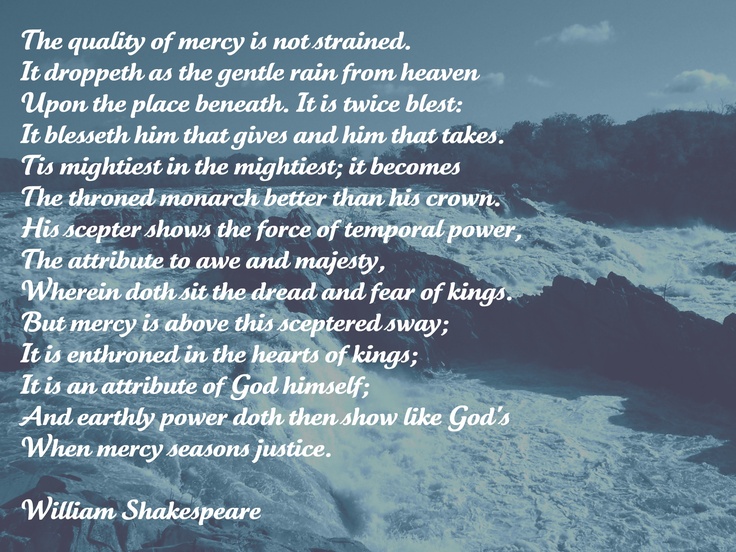
The quality of mercy is not strained: it drops on to the world as the gentle rain does – from heaven. It’s doubly blessed. It blesses both the giver and the receiver. It’s most powerful when granted by those who hold power over others. It’s more important to a monarch than his crown. His sceptre shows the level of his temporal power – the symbol of awe and majesty in which lies the source of the dread and fear that kings command. But mercy is above that sceptered power. It’s enthroned in the hearts of kings. It is an attribute of God himself. And earthly power most closely resembles God’s power when justice is guided by mercy. Therefore , although justice is your aim, think about this: none of us would be saved if we depended on justice alone. We pray for mercy and, in seeking it ourselves, we learn to be merciful.


What is MERCY?  We need to delve a bit deeper into the etymology of this word to understand its full meaning. There are several Hebrew words that are associated with God's mercy:

Kapporeth – means "ransom," "propitiatory," or "the mercy seat."
Racham – means "to love," "to have compassion," or "to show mercy."
Hesed – means "goodness," "kindness," "mercifulness," or "loving-kindness. Hesed is one of my favorite Hebrew words, as it denotes the Convenant between God and His people.  From this comes the Latin translation by St. Jerome, misericordia, from whence we get the word piety.  So often people misconstrue piety as some sort of sweet pious nonsense, when in actuality it has a much richer meaning, one we all need to pray for. 


Thursday, January 14, 2016

THE GIRLS of ANZAC


ANZAC Square Memorial- Brisbane
Having watched the wonderfully done series by Australian TV ANZAC Girls (2014) I thought it a good story to follow on the heels of our religious nurses in the Civil War. 

The six-part series tells the rarely told true stories of the nurses serving with the Australian Army Nursing Service at Gallipoli and the Western Front during the First World War. The series is based on Peter Rees' book The Other ANZACs as well as diaries, letters, photographs and historical documents.


The action begins as the nurses arrive in Cairo in 1915, taking us to the senseless battle of Gallipoli, where Australian and New Zealand soldiers were caught in a month long stalemate with the Ottoman army. There is plenty of blood and gore and many scenes may be too much for some, but they certainly give pause to what these brave women experienced before the advent of antibiotics and modern technology in the surgery.


By the end of The Great War, forty-five ANZAC (Australian and New Zealand Army Corps) nurses had died on overseas service and over two hundred had been decorated. These were women who left for war on an adventure, but were soon confronted with remarkable challenges for which their civilian lives could never have prepared them.


They were there for the horrors of Gallipoli and they were there for the savagery the Western Front. Within twelve hours of the slaughter at ANZAC they had over 500 horrifically injured patients to tend on one crammed hospital ship, and scores of deaths on each of the harrowing days that followed. Every day was a nightmare but their strength and humanity were remarkable.


This is a very human story from a different era, when women had not long begun their quest for equality and won the vote. They were on the frontline of social change as well as war, and the hurdles they had to overcome and the price they paid, personally and professionally, make them a unique group in ANZAC history.


Saturday, January 9, 2016

PRAYER FOR MERCY

Pope Francis' Prayer for the Extraordinary Jubilee Year of Mercy


Virgin of Mercy- Italian 16th C.
Lord Jesus Christ, you have taught us to be merciful like the heavenly Father, and have told us that whoever sees you sees Him. Show us your face and we will be saved. Your loving gaze freed Zacchaeus and Matthew from being enslaved by money; the adulteress and Magdalene from seeking happiness only in created things; made Peter weep after his betrayal, and assured Paradise to the repentant thief. Let us hear, as if addressed to each one of us, the words that you spoke to the Samaritan woman: "If you knew the gift of God!"

You are the visible face of the invisible Father, of the God who manifests his power above all by forgiveness and mercy: let the Church be your visible face in the world, its Lord risen and glorified. You willed that your ministers would also be clothed in weakness in order that they may feel compassion for those in ignorance and error: let everyone who approaches them feel sought after, loved, and forgiven by God.

Send your Spirit and consecrate every one of us with its anointing, so that the Jubilee of Mercy may be a year of grace from the Lord, and your Church, with renewed enthusiasm, may bring good news to the poor, proclaim liberty to captives and the oppressed, and restore sight to the blind.


We ask this through the intercession of Mary, Mother of Mercy, you who live and reign with the Father and the Holy Spirit for ever and ever. Amen.

Tuesday, January 5, 2016

NUNS on the BATTLEFIELD

In this past year, there were some remarkable BBC presentations of women nurses on the battlefield of various wars, most notable was "The Girls of Anzac".  I find their stories, based on letters and journals, worthy of Blogs as they epitomize mercy under stress. I will convey these fascinating tales between Blogs on the Year of Mercy and how relevant they are in our modern world.


The Memorial- Jerome Connor artist
Recently, I saw a photo of a lovely  monument  in Washington, D.C., across from St. Matthew’s Cathedral,  which  is dedicated to the women religious who ministered to wounded and dying soldiers, North and South, during the American Civil War. Unveiled on September 20, 1924, the inscription reads:

They comforted the dying, nursed the wounded, carried hope to the imprisoned, gave in His name a drink of water to the thirsty.  To the memory and in honor of the various orders of Sisters who gave their services as nurses on battlefields and in hospitals during the Civil War.

Between 1861 and 1865, approximately 640 women from twenty-one different religious communities volunteered their nursing services. Mary Livermore, a future women’s rights leader who worked with the U.S. Sanitary Commission, said:

I am neither a Catholic, nor an advocate of the monastic institutions of that church . . . But I can never forget my experience during the War of the Rebellion . . . Never did I meet these Catholic sisters in hospitals, on transports, or hospital steamers, without observing their devotion, faithfulness, and unobtrusiveness. They gave themselves no airs of superiority or holiness, shirked no duty, sought no easy place, bred no mischiefs. Sick and wounded men watched for their entrance into the wards at morning, and looked a regretful farewell when they departed at night.


Before the Civil War, nuns often didn’t wear habits in public or when traveling, because of anti-Catholic hostility. But when the war came, they were desperately needed. In general, nursing wasn’t considered a respectable profession for women. Nor were there many hospitals; most people were cared for at home. The exceptions here were the Sisters, who operated twenty-eight hospitals nationwide as of 1861. While other churches had women nurses, including the Lutherans and Episcopalians, Catholic nuns constituted the single largest pool of experienced nurses in America on the eve of the Civil War.

Altogether on both sides, over 4,000 women served as nurses; more served as nurses’ assistants, cooks, and laundresses. They cleaned wounds and bandaged them, helped doctors in surgery. It wasn’t easy work, and the turnover rate was high. All in all, it was hard, ugly work.

The turnover rate may have been less for the Sisters. For centuries, historian George Stewart writes, nursing was a “religious ministry rather than a profession.” One Sister, asked how she gathered strength to do her work, said: “I thought of the cruel wound in the side of our dear Lord, and my strength was restored.” And they asked little remuneration beyond necessities.


 In some quarters, however, particularly among Protestant nurses,  prejudice still lingered. One woman, describing the Sisters’ habit, said: “What looking objects to wait upon our sick and dying boys!” Dorothea Dix, the Superintendent of U.S. Army nurses, was said to be particularly hostile to Catholics. Part of the reason for this hostility may have been just plain jealousy.


The Sisters evangelized by their example. In many places, they were the first nuns, let alone Catholics, that some soldiers had ever seen.

They were there on the war’s bloodiest battlefields. At Shiloh, where some 25,000 fell, Sister Anthony O’ Connell, a Cincinnati-based Sister of Charity, said she was unable to bear the terrific stench from the bodies on the battlefield. This was bad enough, but what we endured on the field of battle while gathering up the wounded is beyond description . . . Day often dawned on us only to renew the work of the preceding day without a moment’s rest.


One soldier said of Sister Anthony:

Amid this sea of blood she performed the most revolting duties for these poor soldiers. She seemed like a ministering angel, and many a young soldier owes his life to her care and charity. Happy was the soldier who, wounded and bleeding, had her near him to whisper words of consolation and courage. She was reverenced by Blue and Gray, Protestant and Catholic alike; and we conferred on her the title of the ‘Florence Nightingale of America.’ Her name became a household word in every section of the North and South.

When surgeons wanted to amputate a soldier’s limb, she would say: “Wait and let me see what I can do for him.” And she often saved it. In 1897, she was buried with a full military honor guard.

Sister Anthony developed the “Battlefield Triage”. Her method was “the first recognizably modern triage techniques in war zones, saved countless lives through faster hospital treatment and won her praise from President Lincoln”. .

In addition to her courageousness and innovation, some even said that  Sister Anthony’s word was treated as law among officers, doctors and soldiers after establishing herself as a prudent and trusted administrator and nurse. She and other sisters were also often selected to treat wounded prisoners of war due to their showing no bias between Union and Confederate soldiers. She became personally acquainted with Jefferson Davis and knew a number of generals on both sides of the conflict.

Sr. Anthony on the Battlefield
Sister Anthony went on to serve at the battlefields of Winchester, Virginia; the Cumberland Gap, Tennessee; Richmond, Virginia; Nashville, Tennessee; Gallipolis, Ohio; Culpeper Court House, Virginia; Murfreesboro, Tennessee; Pittsburg Landing, Tennessee; and Lynchburg, Virginia. She also served on a hospital ship on the Ohio River.

After the war, in 1866, Joseph C. Butler and a friend, Louis Worthington, purchased a large building at Sixth and Lock Street, to present to Sister Anthony as a gift in recognition of her and the sisters service during the war. This was given with two conditions: that no one be excluded from the hospital because of colour or religion, and that the hospital be named “The Hospital of the Good Samaritan,” to honour the sisters’ kindness. Sister Anthony was also recognized for her work during the yellow fever epidemic of 1877.

She passed away in her sleep in December 1897 in Cumminsville, Cincinnati, Ohio.It should be noted that she came from the same Community that produced Sr. Blandina Segale (see Fastest Nun in the West- Blog  7/3/14)

In his eulogy for Sister Anthony at her funeral in 1897, Bishop Thomas Byrne of Nashville, Tennessee, one of the cities where she nursed the wounded during the Civil War, reminded mourners of her motivation:

 “Christ was her inspiration, and for this reason she trod the battlefield and entered hospitals pregnant with pestilence. Her presence was more to those brave sons of America than that of an angel. Yet she was only a type of many.”



Friday, January 1, 2016

MERCY IN THE NEW YEAR


For 2016 I will do some Blogs relating to the Jubilee YEAR  of MERCY, as proposed by Pope Francis.

What is the Year of Mercy?  It is a remarkable occasion during which the entire Catholic Church,  opens wide the doors to the saving mercy of Christ. The Year of Mercy is celebrated from December 8th, 2015- the Feast of the Immaculate Conception and the 50th anniversary of the closing of Vatican II- to the Solemnity of Christ the King on November 20, 2016.

During this special period of time in the Church, Pope Francis calls all Catholics to be profound witnesses to mercy and to "find the joy rediscovering and rendering fruitful God's mercy, with which we are all called to give comfort to every man and every woman of our time."

Jubilee years have traditionally been called every 25 to 50 years. The most recent one was called by Pope St. John Paul II in the year 2000. Throughout Church history there have been 26 ordinary Jubilees and only 3 extraordinary Jubilees. Pope Francis has specifically titled this year's Extraordinary Jubilee as the Year of Mercy.


Judy Gorecki (for the Diocese of Pittsburg)
Like all past Jubilees in the Church, the Year of Mercy features a very special plenary indulgence, ie. the complete remission of all temporal punishment due to sin. In celebration of this Extraordinary Jubilee, Pope Francis is making the indulgence as widely available as possible.

"To experience and obtain the Indulgence, the faithful are called to make a brief pilgrimage to the Holy Door, open in every Cathedral or in the churches designated by the Diocesan Bishop, and in the four Papal Basilicas in Rome, as a sign of the deep desire for true conversion."

To receive the Jubilee Year indulgence, you must fulfill the usual conditions:  It is appropriate, but not necessary, that the sacramental Confession and especially Holy Communion and the prayer for the Pope's intentions take place on the same day that the indulgenced work is performed; but it is sufficient that these sacred rites and prayers be carried out within several days (about 20) before or after the indulgenced act. Prayer for the Pope's intentions is left to the choice of the faithful, but an "Our Father" and a "Hail Mary" are suggested. One sacramental Confession suffices for several plenary indulgences, but a separate Holy Communion and a separate prayer for the Holy Father's intentions are required for each plenary indulgence.

If one is not able to visit a designated Catherdral or Church due to distance, illness or work, one may perform Corporal or Spiritual Works of Mercy.


What are the Corporal Works of Mercy? Feed the hungry, give drink to the thirsty, clothe the naked, shelter the homeless, visit the sick, visit the imprisoned, and bury the dead.

The Spiritual Works of Mercy: Admonish the sinner, instruct the ignorant, counsel the doubtful, bear wrongs patiently, forgive offenses willingly, comfort the afflicted, and pray for the living and the dead.

Wednesday, December 30, 2015

CHRISTMAS ARTIST

Coming of the Magi
While perusing art for my Christmas Blogs, I found this woman whose sheep I love, and thought her work appropriate for the season.

Scottish Artist FRANCES WATT is a woman of mystery in contemporary art.  At the peak of her career in the 1960s, she achieved some measure of success as an artistic chronicler of the male-dominated world of money-making in London’s Square Mile financial district. By the early 1990s, Frances and her art were all but forgotten. The recent sale of a cache of pieces, kept in storage for 30 years in Aberdeen, has drawn well-deserved attention back to an artist.

Edith Frances Watt was born in 1923 in Falkirk, Scotland, the daughter of a Church of Scotland minister. When she was three, her father was called to the Scottish Kirk in Geneva, Switzerland, where she spent her childhood. The family returned to Scotland in 1936, and when her father died two years later, Frances and her mother moved to Highgate, London. She would live there unmarried for most of her life, devoting her time to drawing and the local choral society for which she designed programs.


She had formal art training at the Byam Shaw School of Drawing and Painting in London, honing her skills by copying the Great Masters. 

Her first public exhibition was in the 1950s. A decade later, she was commissioned by the Council of the Stock Exchange to create a visual record of business activities at The City.


Working in pencil, pen, and watercolor she made hundreds of studies of anonymous financiers at desks and on the trading floors  at the Royal Exchange, the London Discount Market, and Lloyds of London, many of them, used as illustrations in the Times newspaper. Frances's drawings on biblical themes present a very different side of this impersonal chronicler of the Square Mile.

Her love for animals also found expression in a whimsical watercolor of Jesus tenderly taking a roadkill rabbit into his arms. A dog and a sheep also figure as two more traveling companions for the Risen Christ and two disciples in a mixed media painting of the Road to Emmaus story in Luke 24:13-32.

Frances wrote on the margin of the painting: Joy of companionship...The earth is subject to Him...The animals recognize Him...The GREAT PEACE has come into the World...Atmosphere-Peace.